"Is this site legit" usually means three separate questions bundled together, and the answer differs for each.
Is it a real company, or a front that will take my data and vanish? Will I actually get paid for work I complete? And is the money worth the hours, once the unpaid parts are counted?
Most established platforms pass the first easily, pass the second usually, and fail the third routinely. Here is how to check all three before spending an evening rather than after. Anyone starting from nothing may want what genuinely accepts beginners first, while the micro-jobs-online route shows how a proof-based task moves from listing to withdrawal. The same checks matter when comparing app-testing tasks, UGC creator jobs and other platforms that ask for work before payout.
First: is the company real
Fastest checks, in order.
Find the registered entity
Legitimate platforms name a company somewhere, usually in the terms or the privacy policy. Search the name in the relevant company register — most countries publish one free. A platform with no identifiable legal entity is the clearest warning available.
Check how long the domain has existed
A public WHOIS lookup shows registration date. A site advertising established earnings on a domain registered three months ago is describing something that has not happened yet.
Read the privacy policy for where data goes
Not the whole thing. Search it for who receives your information and whether it is sold. A platform that intends to monetise your data rather than your work usually says so somewhere, in the least readable paragraph.
Look for a physical address and a real support route
An address that is a virtual office is common and fine. No address at all, and support only through a web form, is worse.
These four take ten minutes and eliminate the outright fraudulent tier.
Second: will you be paid
This is where genuinely registered companies still differ enormously, and where almost nobody looks.
Is the buyer's money committed before you start? On a task marketplace this is the single most important term. Funded up front means the payment is already held before the brief goes live, so a buyer who disappears is the platform's problem. Unfunded means you are extending credit to a stranger for a fifteen-dollar job.
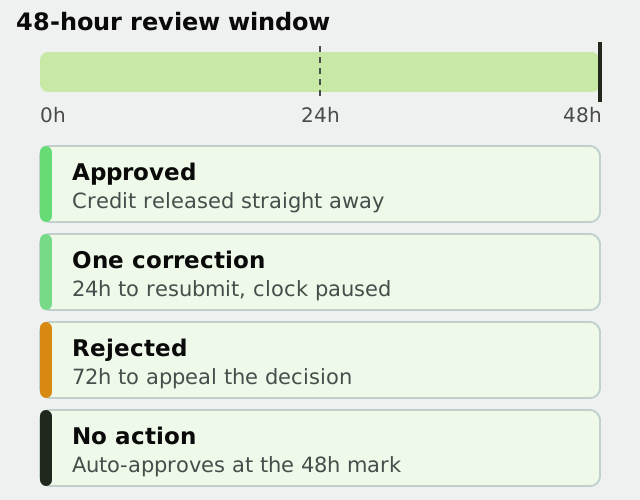
Is there a stated review window? And does unreviewed work approve automatically at the end of it? Without that, a buyer who simply stops responding can hold your submission indefinitely.
Can a rejection be challenged? The term people skip and the one that matters most. If your work can be refused with no explanation and no route to appeal, you are carrying the entire risk of somebody's mood, and the platform has no incentive to intervene.
How many revisions can be demanded? One correction with a deadline is reasonable. Unlimited revisions convert a fixed payment into open-ended work.
What is the withdrawal minimum, in hours? Divide the threshold by the realistic hourly rate. If the answer is weeks, the threshold is doing real work for the business, because unreached balances cost them nothing.
What are the payment rails and fees? Currency of credit, currency of withdrawal, the conversion rate against mid-market, and any flat fee. A worked example of how one platform's payout path actually runs shows what to compare against. Five to twenty percent commonly disappears here without appearing anywhere in the marketing.
Of those, the review clock is the one that decides how long finished work can sit unpaid.
Third: is it worth the time
A platform can be entirely legitimate and still waste your evening. This is the most common outcome and the one people mistake for being scammed.
Calculate the effective rate, not the listed rate. Include time spent finding tasks, reading briefs, being screened out, and waiting. Survey platforms are the clearest example: the advertised rate ignores screen-outs, which are unpaid and frequent, and the honest figure often lands between one and four dollars an hour.
Check whether unpaid screening exists. Some platforms make you answer qualifying questions before revealing whether you are eligible. That time is yours and it is not compensated.
Look at what raises the rate. Task work restricted by country, language, device or skill pays several times what open global work pays, because the eligible pool is a fraction of the size. If a platform has none of that restriction, expect the bottom of the range.
Ask whether the work compounds. General task work does not — finishing one leaves you where you started. Content and specialist work builds a portfolio that raises what you can charge. Neither is wrong, but only one has a rate curve.
The twelve-point check
Run this before creating an account anywhere.
- Is there a named, findable registered company?
- How old is the domain?
- Does the privacy policy say who receives your data?
- Are you being asked to pay anything, for any reason?
- Does earning depend on recruiting other people?
- Is the rate quoted in real currency rather than points?
- If points, can you find the conversion in under a minute?
- Is the buyer's money committed before work starts?
- Is there a stated review window with automatic approval?
- Can a rejection be appealed to someone neutral?
- What is the withdrawal minimum, expressed in hours of work?
- What do the payment rails cost, including conversion?
Reading reviews without being misled
Worker reviews of these platforms are the obvious research step and they are unusually unreliable, in both directions.
Negative reviews skew toward rejection
People write reviews after something went wrong, and the most common trigger is having work refused. Some of those rejections were deserved. The review never says which, because the writer does not believe theirs was.
Positive reviews skew toward referral links
A large share of enthusiastic writing about task platforms exists to earn a referral commission. The tell is an article listing twelve platforms warmly with no rate attached to any of them.
Both skew toward the loudest period. A platform that changed its terms two years ago still carries reviews describing the old ones, and a platform that changed last month has none describing the new ones.
What to read instead: complaints that describe a mechanism rather than an outcome. "They rejected my work" tells you nothing. "They rejected my work and there was no way to ask why" tells you the appeal route does not exist, which is a structural fact you can verify yourself in the terms.
Then verify it. Every mechanism worth caring about is written down somewhere in the terms of service, and reading the two relevant paragraphs beats reading fifty reviews.
Verifying the pay before you commit
The advertised rate is the least reliable number on any of these sites. Three ways to get a real one.
Do one task and time everything. Including finding it, reading the brief, and any screening. Divide the payment by the total. That single number is more informative than every review you could read.
Ask what proportion of submissions get approved. Some platforms publish it and most do not, but support will sometimes answer. A low approval rate turns an advertised rate into a fraction of itself.
Check whether the good tasks are gated. Many platforms tier access, with higher-paying work unlocked by completing a volume of lower-paid work first. That is not unreasonable, but the entry rate is then not the rate you were shown, and the climb is unpaid in effect.
The patterns behind most complaints
Reading enough worker complaints, the same five structures produce nearly all of them.
Points economies. Earnings in coins, gems or credits, with a conversion rate that is hard to find and a threshold that is hard to reach. Legal, and functionally a way of not paying a good share of users.
Unpaid screening. Fifteen minutes of qualifying questions to be told you do not fit. Repeated across a week this is hours of unpaid work that never appears in any advertised rate.
Silent rejection. Work refused with no reason and no appeal. Occasionally deserved and impossible to distinguish from the alternative, which is the problem.
Account closure holding a balance. Accounts closed for a stated policy breach with earnings unpaid. Sometimes justified, and worth knowing whether the terms permit forfeiting a balance at all.
Slow drift downward. Rates that fall gradually as the platform's worker supply grows. Not fraud, just the market, and a reason not to build a plan on one platform's current rate.
None of these require a platform to be fake. They are all things real companies do, which is why "is it legit" is the wrong question to stop at.
What good task work actually looks like
Worth stating positively, because the warnings dominate this subject.
Real, well-paid task work is specific. The brief says exactly what to do, exactly what proof to submit, and exactly what it pays, before you commit. Eligibility is checked up front rather than after you deliver. The money exists before you start. Review happens on a stated clock. Disagreements go to somebody who did not make the original decision.
Where those conditions hold, the work is ordinary paid work with an unusually short unit size, and the rate reflects how scarce the eligible pool is rather than how desperate the worker is.
Where they do not hold, no amount of platform reputation compensates, because every one of them is a place where the cost of a disagreement lands on you.
Protecting yourself while you test one
A few habits cost nothing and remove most of the downside of trying somewhere new.
Use a separate email address for platform signups. It keeps the marketing out of your inbox and makes it obvious later where a leak came from.
Do not reuse a password. Task platforms are not high-security environments and several have been breached over the years.
Be deliberate about identity documents. Verification is normal on platforms handling real money, and its complete absence is a warning rather than a convenience. What is not normal is a platform wanting a passport scan before showing you a single task. Establish the company is real first.
Read the permissions any app requests against what the work requires. A feedback app needing your contacts is not doing feedback.
Withdraw early and often at the start. Do not accumulate a balance on a platform you have not yet been paid by once. The first small withdrawal is a test, and it is cheap to run.
Keep your own record of what you completed. Task, date, promised payment, actual payment. If a dispute happens, the platform's record is the only other copy.
A reasonable way to start
Pick one platform that passes the twelve points. Complete the profile properly, including country and languages, since those determine which of the better-paid restricted briefs you are eligible for.
Take one small task and follow it all the way through to money arriving in your own account. That single loop teaches you more than any review: how long approval takes, what the fees really are, whether verification works from where you live.
Then decide. If the effective rate after that first loop is worth your evening, widen out. If it is not, you have lost an hour rather than a month, which is the entire point of checking first.
For what the various options actually pay per hour once the unpaid time is counted, the comparison of home side hustles sets them side by side.
The check applies just as much to offers of free products in exchange for a review, where the terms decide whether you are being paid or merely occupied — what free product testing actually gives you works through it.