There is no shortage of places advertising UGC creator jobs. There is a considerable shortage of places where the money is already committed, the usage rights are stated, and somebody will tell you why you were rejected. Sorting one from the other is most of the skill in finding work.
This covers the four routes that actually hire, what each pays, and how to apply in a way that gets read. If the job itself is still unclear, start with what a UGC creator is. The wider category around it — employed roles, agency production, freelance and platform monetisation — is covered in the five routes into paid content work.
Brief Buck belongs to the marketplace route: brands post a bounded video task with a reward, number of spots, audience rules, usage terms and proof requirement. It does not promise a salaried creator role or a permanent queue of briefs. Browse currently visible UGC tasks before building a profile around work that may not match your country, camera preference or category.
UGC jobs for beginners
You do not need a paid client history to begin, but brands still need evidence that you can follow a brief and return a usable clip. For a beginner, that evidence is a small portfolio of clearly labelled sample work rather than a resume or a follower count.
Start with products you already own. Film three or four short samples in one category: a demonstration, an honest first-impression clip, a problem-and-solution hook, and a hands-only or voiceover version if you do not want to appear on camera. Label them as sample or spec work; never imply a brand commissioned content that it did not commission.
The beginner-friendly briefs are the ones with a bounded deliverable, a visible reward, a simple usage licence and no requirement to publish to your own audience. A listing that asks for a complicated script, several locations, heavy editing or unlimited advertising rights is not beginner work merely because its rate is low.
Before applying, check four things:
- Can your samples prove the requested format? A skincare demonstration is stronger evidence for a skincare brief than five unrelated clips.
- Are the reward and usage rights visible? Organic posting and paid advertising are different licences, even when the video file is identical.
- Does the brief buy content or audience access? Content-only UGC normally does not need followers. Publishing to your own account is an additional influencer deliverable.
- Can you meet every practical requirement? Country, language, device, camera appearance and deadline still matter even when prior client work does not.
That is what “beginner” means here: no paid history required, not no sample, no brief discipline or no standard to meet. The fastest next step is to build the small portfolio once, then apply only where it is relevant.
The four routes, compared
| Route | Typical rate | Time to first booking | Competition | Best for |
|---|---|---|---|---|
| Marketplaces | $50 – $150 | 2 – 8 weeks | High | Building a portfolio and first credits |
| Direct outreach | $150 – $500 | 4 – 12 weeks | Low | Highest hourly rate once established |
| Agencies | $75 – $200 | 6 – 16 weeks | Medium | Steady volume with no prospecting |
| Brand talent pools | $100 – $300 | Varies | Medium | Repeat work with one company |
Nobody uses only one. The workable pattern is marketplaces to build credits, then direct outreach on the back of those credits, with agency work filling gaps.
Marketplaces
Brands post a funded brief and creators apply or reserve a spot. This is the fastest way to a first paid clip because the budget exists before you film, and you are not persuading anyone that the category is worth trying.
The trade is rate and competition. A straightforward unboxing brief at $30 can draw a hundred applicants in an afternoon, and the platform has no reason to slow that down.
What separates a good marketplace from a bad one comes down to four things you can check before signing up:
Is the rate visible before you apply? Anything that says "competitive" or "DOE" is filtering for people who will accept whatever arrives.
Is the campaign funded up front? If the brand pays after approving, the platform has passed the payment risk to you. Funded means the money is held before the brief goes live, so a brand that vanishes mid-campaign is the platform's problem rather than yours.
Are usage rights stated in the brief? A clip licensed for organic posting is a different product from one licensed for paid advertising in perpetuity. When the brief is silent, assume the broadest interpretation and price accordingly, or ask before reserving.
Is there a route to challenge a rejection? This is the one most creators do not check until it matters. On platforms where rejection is final and needs no explanation, a brand can reject work it intends to use, and there is no mechanism to argue. Look for a stated appeal window and somebody neutral deciding it.
On Brief Buck, campaigns show the rate, the eligible countries and the exact proof required before you reserve, funding is held before the brief publishes, posters get one correction request rather than unlimited revisions, and a rejection opens a a rejection you can actually contest decided by an administrator rather than by the poster who rejected you.
Applying to marketplace briefs
Volume matters early, but generic volume does not. The applications that convert do three things:
- Match the category. Send skincare samples to skincare briefs. A portfolio spanning six categories reads as a beginner shopping around.
- Reference the specific brief. One line proving you read it — the hook you would open on, the angle you would take — beats a paragraph about your passion for content.
- Answer every stated requirement. If the brief asks for a face-on-camera creator in Germany, confirm both. Reviewers filter on requirements before they watch anything.
Direct outreach
Find brands in your category running paid social with weak creative, and pitch them. This is the highest-paying route per hour worked and the one most creators avoid, which is precisely why it stays open.
Finding targets is mechanical. Meta's public ad library lists every ad a brand is currently running, searchable by company. Spend an hour looking at brands in your category and note which ones are running static images, stock footage, or the same clip for months. Those are the ones with a creative shortage.
The pitch is four sentences and no attachment:
I saw you're running the [specific ad] on Instagram. It's a still image against three competitors using creator video. I'd film three variants of a [specific angle] concept for you at $X each. Portfolio here: [link].
No deck, no biography, no paragraph about storytelling. Reply rates run somewhere between two and eight percent, which sounds bleak until you notice that one reply from fifty emails at $300 a clip beats forty marketplace applications at $40.
Agencies
Creative agencies, performance marketing shops and specialist UGC agencies all subcontract creator work. Once you are on a roster the work is steady and you never prospect again, which is worth a lower rate to a lot of people.
Getting on takes longer. Agencies rarely post openings; they collect creators through referrals and inbound. The approach that works is emailing the person who actually briefs creators — usually a creative strategist or a production coordinator rather than anyone in business development — with a portfolio and your category, and then following up once a quarter without apology.
Expect a rate roughly midway between marketplace and direct. Expect tighter briefs and faster deadlines, because the agency has already promised the client a date.
Brand talent pools
Larger brands maintain their own creator lists and go back to them rather than re-recruiting. Getting in usually means delivering once through another route and being easy to work with, then asking directly whether they keep a roster.
This is the quietest route and the one with the best economics over a year. There is no platform fee, no application, and no competition after the first booking. It is also entirely dependent on your first delivery being clean, which is a decent argument for treating every early booking as an audition.
What a week of applying actually looks like
Creators who land work treat this as a pipeline rather than a lottery. A workable week, once the portfolio exists, runs roughly like this.
Monday
Scan the marketplaces you have joined and shortlist every brief in your category. Do not apply yet. Read all of them first, because a brief posted Friday with forty applicants is worth less of your time than one posted an hour ago.
Tuesday
Apply to eight to twelve of them properly. Twenty minutes each, matching samples to category and answering the stated requirements line by line. This is the part people rush, and rushing it is why the acceptance rate feels random.
Wednesday
Direct outreach. Twenty emails to brands you found in the ad library, four sentences each, no attachments. This block produces nothing for the first three weeks and then starts producing the best-paid work you have.
Thursday and Friday
Film whatever you have been booked for, and if nothing is booked, film one new spec piece. A portfolio that grows by one clip a week is a different portfolio in two months. Building the portfolio itself is a weekend of work.
The pattern that fails is applying in bursts when money is short, then stopping when a booking arrives. Bookings arrive four to six weeks after the applications that caused them, so a stop-start pipeline produces a stop-start income with the gaps in the wrong places.
Getting paid, and what to check first
Payment terms vary more than rates do, and they are worth reading before the rate.
When the clock starts. Some platforms begin the review period when you submit. Others begin it when an administrator has cleared the files. The second is slower to start and considerably better for you, because it means nobody is timing you against a submission that has not been looked at.
What happens if the brand goes quiet. A stated auto-approval window means an unreviewed submission pays out on its own. Without one, a brand that stops replying can hold your work indefinitely and you have no recourse.
How many revisions are allowed. One correction request with a deadline is reasonable. Unlimited revisions is how a $100 booking becomes eight hours of work.
How withdrawal works. Minimum thresholds, transfer method, and how long a payout takes after you request it. A platform paying through international transfer to your own account is straightforward. A platform paying in credits, points, or gift cards is doing something else.
Whether rejection is reviewable. Covered above, and worth repeating because it is the single term most creators skip.
Somebody neutral deciding a disputed rejection is the difference between a marketplace and a suggestion box.
What the listings do not tell you
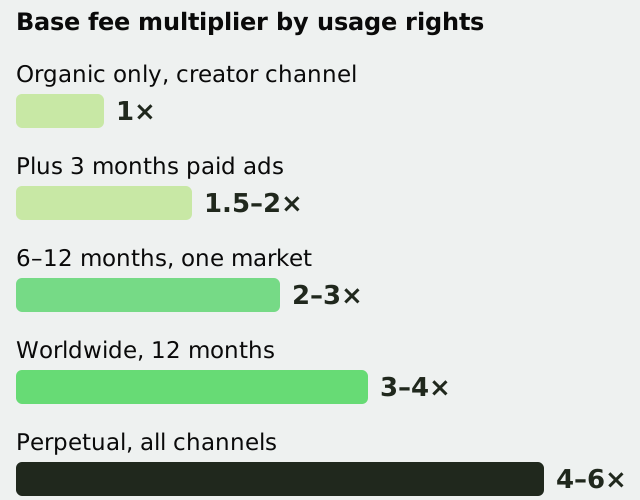
Usage rights are the term that moves a rate most, and what each licence tier is worth is worth knowing before you quote.
Working outside your own country
Geography changes this job less than it changes most freelance work, because the deliverable is a file. It changes two things that matter.
Which briefs you are eligible for
Campaigns often target specific countries, either because the product only ships there or because the brand is buying an accent, a language, or a recognisable setting. A creator in Manila can film a perfectly good clip for a US skincare brand, and the brand may still restrict the brief to US creators because the kitchen behind you is part of what they are buying. That is not a judgement on the work. Read eligibility before you invest an afternoon.
How the money reaches you
International transfer costs and currency conversion quietly remove ten to twenty percent of a small payment if the platform routes it badly. Before committing, find out what currency you are paid in, what the conversion rate is against the mid-market rate, and whether there is a minimum withdrawal that will strand your balance. A $60 clip that arrives as $48 has a different hourly rate than the listing suggested.
Time zones are the one place where distance genuinely helps. A creator eight hours ahead of the client delivers overnight, which reads as fast turnaround without any extra effort.
Getting the first one
The gate is a portfolio, and the portfolio does not require anyone's permission. Four clips, one category, products you already own, filmed exactly as if briefed, labelled honestly as spec work. That takes a weekend.
After that it is application volume with category discipline. Most creators who report that UGC "does not work" applied to fewer than ten briefs, scattered across unrelated categories, with a portfolio that matched none of them. The ones who get booked applied to thirty in one category and treated each rejection as a brief they had misread.
Once two paid clips exist, swap them into the portfolio in place of two spec pieces and raise the rate. Then keep doing that until the rate stops clearing, which is how you find out what you are worth without guessing.