Three platform models get grouped together and they solve different problems. A microtask platform distributes small, discrete units of work across many people. It is not simply a freelance marketplace with lower prices, and treating it like one creates the wrong brief, review process and expectations on both sides.
A freelance platform matches a client to one person for a contract of meaningful size, with proposals, interviews and milestones. A gig platform sells a packaged deliverable at a listed price. A task marketplace takes one brief and runs it across many people, each doing a small unit of it. The third model is also called microtasking. It is the one nobody has a clear mental model for, which is why work that suits it usually ends up somewhere it does not fit. If you want the whole mechanism in one place rather than the marketplace shape specifically, how Brief Buck works end to end covers it.
The distinguishing question
Do you want to choose a person, or do you want an outcome that requires many people?
When choosing is the point
You want a designer whose portfolio you like, working over three weeks. Everything about a freelance platform is built for that, and a task marketplace has nothing to offer. Where each freelance platform fits covers that side of the choice.
When choosing is irrelevant
You need thirty people in four countries each spending fifteen minutes, and no individual among them is the point. Interviewing is not a useful step: there is nothing to select for beyond eligibility, and the coordination of thirty separate engagements is the entire cost you are trying to avoid.
That is the whole distinction. It is not about job size, price, or skill level, though those correlate.
What work belongs on a microtask platform
| Job | Suits a task marketplace |
|---|---|
| Thirty short videos to one brief, three countries | Yes |
| One brand film | No |
| Twenty-five people testing signup on their own phones | Yes |
| A three-week engineering contract | No |
| Structured feedback on a design from forty people | Yes |
| A logo | No |
| Checking a listing renders correctly in six markets | Yes |
| Ongoing bookkeeping | No |
The pattern in the yes column: the answer comes from a sample rather than from expertise, and the value is in the count and the consistency of the question.
How it works on this platform
One brief, split in two
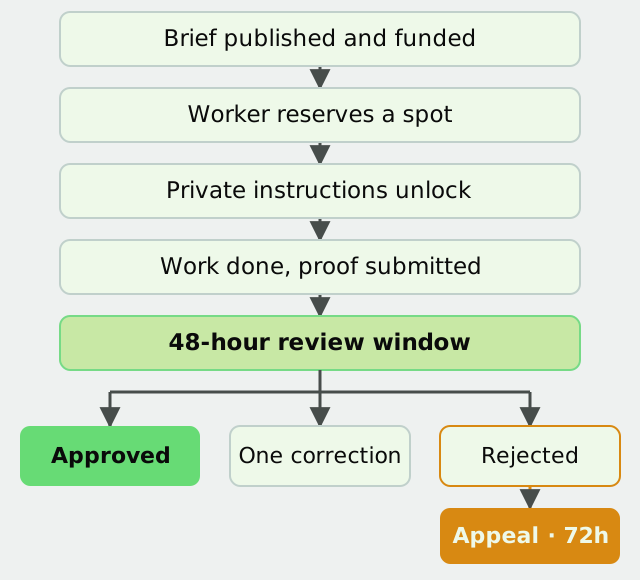
A public part everyone reads to decide whether they can do it, and a private part that unlocks only on reservation. Campaign URLs, promo codes and sensitive detail live in the private half rather than in a public listing.
You set the reward and the spots
The worker fund is reward multiplied by spots. A disclosed 10% Brief Buck platform fee is added, and the full total is paid before publication. Every reserved spot is already funded.
Targeting decides who can take it
Worldwide, a region, named countries or named cities, with language requirements on top. Eligibility is checked at the point somebody tries to reserve, not after they deliver.
Proof is specified up front
A link, a screenshot, a photograph, a video file, a written note, or a combination. What you ask for is what gets checked, which is what makes review fast enough to do forty times.
Review runs on a clock
Approve, request one correction, or reject. Unreviewed work approves automatically after 48 hours. Approval credits the worker and debits the campaign reserve in one balanced ledger entry.
Every campaign runs that same loop, whatever the work is.
What it costs
You set the number, so the cost is a decision rather than a lookup. Rough guides by task length:
| Task | Reward per person |
|---|---|
| Short check or written note, under 10 minutes | $3 – $10 |
| Standard task with proof, 15–25 minutes | $10 – $30 |
| Short-form video to brief | $80 – $150 |
| Extended session or multi-step task | $25 – $60 |
| Narrow country, language or device requirement | Add 25–100% |
The premium on narrow requirements is not arbitrary. A brief restricted to one city, one language or one device model has a small eligible pool, and a rate set for an open global brief will not fill it.
For the people doing the work
A marketplace is only as good as the pool willing to take the next brief, so the worker-side terms are not a courtesy — they are what determines whether a buyer gets results.
The money exists before the work does. A campaign cannot publish unfunded. The full payout path sets out when a balance credits and how withdrawal works. Reserving a spot means reserving against committed money rather than against somebody's intention to pay.
The clock is bounded and starts fairly. Review runs 48 hours and only begins once submitted files have cleared safety review, so nobody is timed against media that has not been looked at. Unreviewed work approves automatically.
Revisions are capped. One correction request, 24 hours to respond. A poster cannot iterate indefinitely against a fixed payment.
Rejection is reviewable. A how disputes are settled decided by an administrator rather than by the poster who rejected the work. This is the term most platforms in the category omit, and its absence is what makes a marketplace unsafe to work on however good the rates look.
Reservations release cleanly. An unused reservation can be released, restoring capacity and removing unattached uploads.
Writing a brief a stranger can execute
Everything about whether this model works for you comes down to one thing, and it is not the platform. Thirty people will read your brief without the chance to ask you a question, so ambiguity multiplies instead of being resolved.
Anyone comparing microtask platforms should check those five things before comparing rates. The wider guide to whether microtask sites are legitimate covers how to verify them yourself.
Five habits fix most of it.
One action per instruction. "Sign up and complete your profile" reads as one step and gets reported as one vague sentence. Split it.
State the format of the answer, not just the question. "Note the price" returns "about twelve euros", "€11.99" and "cheaper than last time". "Note the price as it appears on the label, in the local currency, digits only" returns comparable data.
Cover the failure paths. What should somebody do if the page will not load, the product is out of stock, the code never arrives? Without an instruction, each person improvises, and the improvisations are the submissions you cannot use.
Ask for evidence alongside the answer. A photograph next to a stated price makes the record checkable and changes how carefully people answer.
Pilot on five before funding fifty. Reading five responses tells you immediately which requirement was ambiguous. Fixing it then costs five rewards instead of fifty.
Both sides of the same terms
One thing worth noticing about how this model is built: the terms that protect a worker are the same ones that produce results for a buyer.
Funded campaigns mean workers are not carrying payment risk, which is why they take the brief at all. Automatic approval means a busy poster does not accumulate a reputation for silence, which is why the next campaign fills. Bounded corrections stop a fixed reward becoming open-ended work, which is why experienced people take briefs rather than avoiding them. An appeal route means a rejection is a decision rather than a risk, which keeps the pool willing to submit at all.
A marketplace that strips those terms looks cheaper to a buyer for about a quarter, and then the supply thins and the briefs stop filling.
The terms are not generosity. They are the mechanism that keeps a pool available to sell.
Where this model breaks down
Being honest about the limits is more useful than a feature list.
Ambiguous briefs fail at scale. Thirty people interpreting a vague instruction produce thirty interpretations. On a freelance contract one person asks a clarifying question; here nobody does, and you find out at review. The brief has to be executable by a stranger without a conversation.
Sustained relationships are awkward. The model is built around discrete units. If what you want is the same person for ten hours a week, hire them.
Very narrow targeting has thin supply. A brief restricted to one city in a small market may simply not have an eligible population, and no amount of budget changes that.
What it looks like from the worker side
Buyers reading this page benefit from knowing how the other side experiences a campaign, because it explains why some briefs fill in hours and others sit.
Somebody browsing sees only campaigns they are eligible for. The reward, the countries, the deadline and the exact proof required are all visible before they commit to anything — there is no application, no proposal, and no waiting to hear back. They reserve one spot, the private instructions unlock, and they have a defined window to complete it.
Two things determine whether they take yours over another. The first is whether the reward is proportionate to the work described, which is a judgement they make in about five seconds. The second is whether the brief reads as though somebody thought about it. A brief with vague requirements signals a review that will be subjective, and experienced people avoid those regardless of the rate.
That second point is the one buyers underestimate. Clarity is not only about getting comparable results; it is about which people choose your campaign in the first place.
Starting
One brief, twenty spots, two markets, proof you would actually check, and a reward you would accept for the time you are asking for.
Read the results before deciding anything about the second campaign. Most of what a first run teaches you is about your own brief, and that lesson costs twenty rewards rather than two hundred. Once the brief works, the same one scales without renegotiation, which is the actual advantage of this model over every alternative.