Payment terms decide whether a platform is worth your evening, and most of them are vague about it on purpose. This page is the specific version: when money appears, when you can move it, what can go wrong, and what protects you when it does. This describes the worker side of the task marketplace model, where the money is committed before a brief publishes.
The sequence
You reserve a spot
The campaign is already funded, because a brief cannot publish without the money committed, so you are working against money that exists rather than against somebody's intention to pay.
You submit proof
Whatever the brief specified: a link, a note, a screenshot, a file, or a combination. Uploaded files are signature-checked and held privately.
The review clock starts
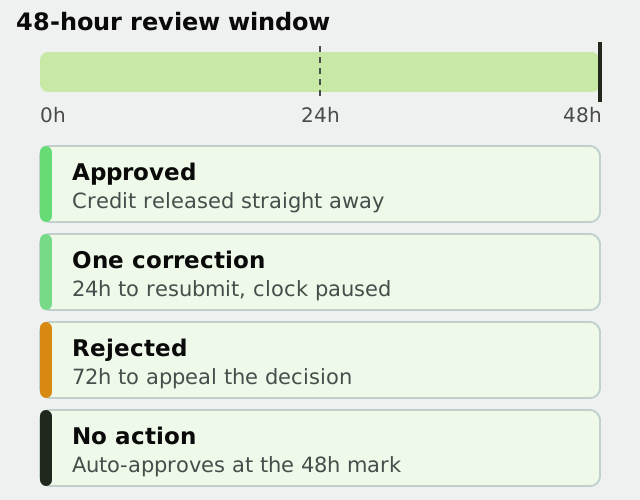
48 hours, beginning once any files have cleared safety review rather than at the moment you hit submit. You are never being timed against media nobody has looked at yet.
The poster approves, corrects, or rejects
Approval credits your available balance immediately. A correction request pauses the clock and gives you 24 hours to resubmit. A rejection opens your appeal window.
Nothing happens? You get paid anyway
Unreviewed work approves automatically at the end of the 48 hours. A busy or absent poster cannot leave your submission in limbo.
You request a withdrawal
Funds move from available to pending atomically. An administrator reviews the request, and Stripe Connect sends an idempotent transfer to your connected account. Wise or manual processing remains a fallback.
What you actually earn
The reward stated in the brief is what credits to your balance on approval. Posters fund the worker reward allocation—the reward per result multiplied by the number of spots—plus a separate 10% Brief Buck platform fee before a campaign is published. That fee does not reduce the worker reward.
That is worth understanding rather than taking on trust, because it explains an incentive. Platforms funded by clipping worker earnings have a structural reason to suppress rates. One funded on the campaign does not, and rates are set by the poster against what will actually fill the brief.
Timing, honestly
Withdrawal is the one that is not instant. Requests are reviewed in batches. For a Stripe-ready worker, starting the batch sends an idempotent Connect transfer and records accepted or failed outcomes automatically. Wise and manual batches use explicit administrator reconciliation.
That last one is slower than the instant-payout promises elsewhere in this category, and we would rather describe it accurately than promise something the current process cannot guarantee. The reviewed step exists because transfer mistakes are difficult to reverse; Stripe automates execution after review without changing the ledger or how your balance behaves.
Fees and what arrives
Two things reduce what lands compared with what you earned, and neither is unique to any one platform.
Currency conversion. If you are credited in one currency and withdraw in another, the conversion rate matters. Compare it against the mid-market rate rather than accepting the number shown.
Transfer costs. Flat fees hurt small withdrawals disproportionately. A flat charge on a small balance is a much larger percentage than the same charge on a batched one, which is a straightforward argument for withdrawing less often in larger amounts.
Neither of these is a platform fee on your earnings. They are the cost of moving money across borders, and the honest thing is to say they exist rather than describe payouts as free.
Your payout destination
The recommended route is Stripe-hosted onboarding from your private dashboard. Stripe collects and verifies the identity and bank details needed to pay you; Brief Buck stores only the connected-account reference and transfer readiness state. You can return to Stripe's Express dashboard to manage the account. Wise remains an optional fallback entered in Brief Buck, shown masked to you and in full only to payout operations.
Two practical notes. The name on the destination should match your account — mismatches are the most common cause of a frozen balance. And verification requirements vary by country, so it is worth checking that yours can be satisfied before you accumulate a balance rather than after.
How your balance is actually recorded
This is more detail than most people want and it is the part that determines whether a balance can quietly go wrong.
Approval writes a single balanced ledger transaction: the campaign reserve is debited and your available balance is credited, in the same operation. It is append-only, so entries are added rather than edited, and every credit traces back to a specific approved submission on a specific campaign.
That structure rules out a class of problem. A balance cannot drift from the sum of what you earned, because the balance is the sum of the entries rather than a number stored separately and updated. If a credit exists, the matching debit exists.
Withdrawals work the same way. A request moves funds from available to pending atomically, and requires an idempotency key so a retried request cannot withdraw twice. Batch outcomes are reconciled explicitly as paid or failed, so a transfer that did not land is recorded as not having landed rather than being assumed.
None of that is visible while things work normally. It matters on the day something does not.
Tax, briefly
Where you live decides what you owe, not where the poster is. If you are unsure how this is treated locally, the question is worth asking once rather than guessing for a year.
When something goes wrong
Your work is rejected. You have 72 hours to appeal, and an administrator decides — not the poster who rejected it. If the rejection is overturned, settlement runs through the same retry-safe path as an ordinary approval, so it cannot half-pay or double-pay.
A correction request seems unreasonable. You can resubmit, or you can decline and let it be rejected and appeal. One correction is the cap; a poster cannot keep asking.
A transfer fails. Failed payouts are reconciled explicitly rather than silently disappearing. The funds return to your balance and you can correct the destination and request again.
You reserved something you cannot complete. Release the reservation. Capacity returns to the campaign and any unattached uploads are removed. Releasing is always better than letting it expire.
Eligibility, and why you see fewer tasks than exist
A common early question is why the marketplace looks thin. Usually it is not thin — you are seeing the subset you are eligible for.
Campaigns target worldwide, a region, named countries or named cities, and can add language requirements on top. Eligibility is checked at the moment you try to reserve, so a campaign restricted to another market never appears as an option rather than being offered and then refused.
Two consequences worth acting on.
Complete your profile properly. Country, city and languages are the fields matching runs on. An incomplete profile silently removes you from campaigns you would have qualified for, and nothing tells you it happened.
Restricted work is the better-paid work. A campaign open worldwide competes with everyone. One restricted to your country, your city or your language competes within a much smaller pool, and rates on those are usually higher because the buyer is paying for scarcity. If you work in a language other than English, that is the most valuable thing on your profile.
Advice worth following
Withdraw once early, for a small amount. Before you accumulate anything meaningful, take a small balance all the way out to your own account. You learn the real timing, the real conversion, and whether verification works from your country — while nothing is at stake.
Then batch. Once you know the path works, fewer larger withdrawals cost less in flat fees than frequent small ones.
Keep your own record. Task, date, reward, and what actually arrived. If a discrepancy ever comes up, the platform's record is the only other copy.
Read the brief's proof requirement before reserving. Most rejections trace to a stated requirement that was missed rather than to work being poor.
Comparing this against other platforms
If you work across several platforms, these are the terms worth lining up side by side. They matter more than the advertised rate, because a good rate on bad terms is a rate you may not collect.
Is the work funded before you start?
If not, you are extending credit to a stranger for a small job.
Does a review clock exist, and does unreviewed work approve?
Without both, silence is an indefinite hold.
When does the clock start?
On submission, or once files have been checked? The second protects you.
How many revisions can be demanded?
One with a deadline is reasonable. Unlimited turns a fixed reward into open-ended work.
Can a rejection be appealed, and to whom?
Ask who decides it, and whether that person had anything to do with the rejection.
What is the withdrawal minimum, in hours of work?
Divide the threshold by the realistic hourly rate. If the answer is weeks, the threshold is doing the platform's work rather than yours.
What do the payment rails cost?
Currency of credit, currency of withdrawal, conversion against mid-market, and any flat fee.
The fifth question is the one that separates platforms most sharply.
An appeal decided by the same person who rejected you is not an appeal.
Run that list once per platform. It takes ten minutes and it is the difference between choosing on marketing copy and choosing on terms.
What this page does not promise
Instant payouts. A guaranteed volume of available work. That every poster will review promptly rather than letting the clock run — some will let it run, and the automatic approval exists precisely for that.
What it does promise is that the money is committed before you start, the clock is bounded, the revisions are capped, and a rejection is reviewable by someone who did not make it. Those four are what actually determine whether a platform is worth working on, and they are the ones worth checking anywhere else you consider.
On the commissioning side the equivalent question is what the payment has to be worth before somebody accepts the task at all, and how research incentives are set works through the arithmetic from there.