Marketplaces tend to describe themselves by what they sell. That is the least informative thing about them, because two platforms selling the same outcome can work in completely different ways underneath, and the way they work underneath decides everything a buyer or a worker actually cares about.
So this describes the mechanism instead. A brief becomes reserved capacity, capacity becomes submitted proof, proof becomes a decision, and a decision moves money. Each of those transitions has rules, and the rules are the reason the thing works or does not.
The shape of the problem
There is a category of work that does not fit either of the two shapes the internet has settled on.
Freelance platforms solve for selection. A client has one job and needs the right person, so the machinery is profiles, proposals, interviews and a contract. It works well, and it works for one person at a time.
Gig platforms solve for packaging. A seller lists a deliverable at a price and buyers purchase it. Also fine, also fundamentally about one transaction with one provider.
Neither shape handles the case where the same small piece of work needs doing by thirty different people, in eleven countries, on their own devices, and where what you need back from each of them is evidence rather than a deliverable.
What selection assumes
That the people are interchangeable in role but distinguishable in quality, and that the effort of choosing between them is worth it. True when you are hiring a developer for six weeks.
What distribution assumes
That the people are genuinely different in a way the brief requires — different countries, devices, demographics, languages — and that the point is coverage, not choosing a winner. True when you need thirty phones in eleven markets.
Distribution needs different machinery. That is what this is.
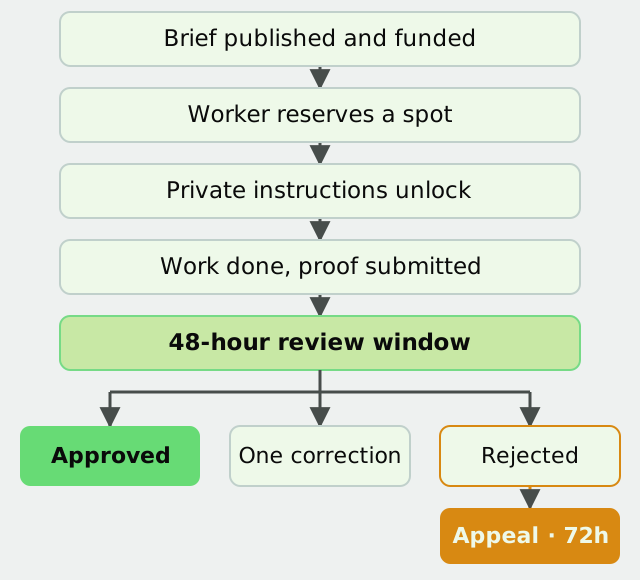
From brief to reserved capacity
A poster describes an outcome, the number of people required, who is eligible, and what evidence counts as proof. That last item is set before anything is posted rather than argued about afterwards, and it is the single most consequential field on the form.
Eligibility is where the pool actually gets built. Country, city, language, device, operating system, sector, and any other filter the brief genuinely needs. Every filter narrows the pool and raises what the work is worth, which is a real trade rather than a free improvement. How country and city targeting changes both the pool and the rate sets out where that curve gets steep.
Then a worker reserves a spot. This is the part most crowdsourcing platforms skip, and skipping it is why they bleed workers.
Open submission means the fifty-first person to finish did the work for nothing. Do that often enough and the good people leave first.
Reservation means a slot is held for you while you work, with an expiry so nobody can sit on capacity indefinitely. The consequence for the poster is a predictable count. The consequence for the worker is that starting a task is not a gamble on being fast enough.
What proof means here
Proof is the load-bearing idea, so it is worth being precise about what it is and what it is not.
It is not a report. A worker writing "completed, went well" is not evidence of anything, and a platform accepting that as a submission has quietly changed what it sells from verified work to a claim about work.
Proof is an artifact produced as a by-product of doing the thing, which would be difficult or pointless to produce without doing the thing. A screen recording of a signup flow. A photograph of a shelf. A file with metadata. A response to a prompt only somebody in that market could answer.
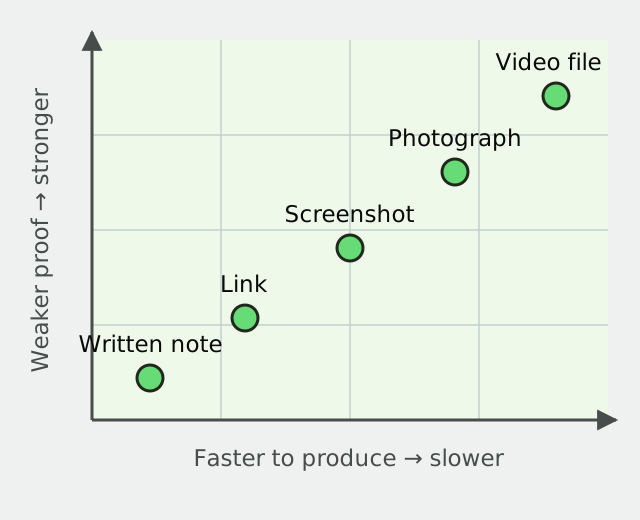
Different work needs different evidence, and the useful question is never "what is the strongest proof" but "what is the strongest proof that is still reasonable to ask for". Demanding notarised documentation for a fifteen-minute task means nobody does the task. The full standard, format by format covers where each one is appropriate.
Review, correction, appeal
This is where marketplaces usually reveal what they actually believe, because a review process is a statement about who is trusted by default.
A submission arrives and the clock starts: 48 hours. The poster can do one of three things.
Approve
The work is accepted and payment proceeds. The ordinary case, and the one the whole design optimises for.
Request one correction
Not unlimited rounds. One. It pauses automatic approval and gives the worker 24 hours to resubmit against the original requirements — the original ones, not new ones added after seeing the work.
Reject
The submission is refused with a stated reason. The worker then has 72 hours to appeal, and the appeal is decided by an administrator rather than by the poster who rejected it.
And if the poster does nothing at all, the work approves automatically when the 48 hours expire.
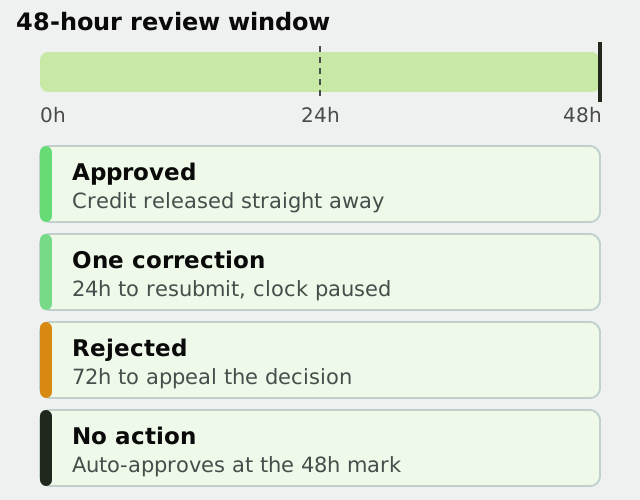
That automatic approval is deliberately blunt, because the alternative is worse. A platform where payment requires a poster to act is a platform where a poster who stops answering emails has, in practice, taken free work. Every marketplace that has let that happen has discovered the same thing: workers stop taking jobs from anyone they have not worked with before, and a marketplace where new posters cannot get their work done is not a marketplace.
The appeal being decided by somebody other than the rejecting poster is the part that costs us the most and matters most. A rejection route that ends with the rejecting party is not a rejection route. How appeals are actually decided, including what evidence tends to settle them is a subject of its own.
When money moves
Money is committed before the work starts. That ordering is the whole point.
A worker deciding whether to spend forty minutes on something is making a bet, and the thing they are betting on is not really whether they can do the work. It is whether the person on the other side will still be there afterwards. Funding the work up front removes that question entirely, which is why the pool of people willing to take unfamiliar briefs stays large.
On approval, the amount is released to the worker's balance and withdrawn through their own payout method. What that looks like from the worker's side, including timing and what gets deducted covers the mechanics.
What the poster is buying
A defined number of verified completions, with the evidence attached and retrievable. Not impressions, not reach, not a promise of effort. A count of things that demonstrably happened.
What the worker is selling
Their time, their location, their device, their language, or their profession — whichever of those the brief actually needed. Priced by how narrow the eligible pool is rather than by how long the task takes.
The parts that are deliberately not negotiable
Every marketplace has a list of things it will not do, and the interesting ones are the profitable things.
We do not accept work that requires a person to misrepresent themselves. Fake reviews, undisclosed paid endorsement, artificial engagement, bulk account creation, anything built to look organic while being paid for. This is turned down regularly and it is not a small amount of revenue.
The reason is structural rather than moral posturing. Our entire mechanism is proof that a real person genuinely did a specific thing. Work whose purpose is to be indistinguishable from something it is not cannot be verified by definition — the deliverable is the deception. A platform selling both verified work and undetectable fake work is selling nothing, because the verification means nothing once the same infrastructure produces both.
A proof system that will also certify a lie is not a proof system. It is a formatting service.
There are adjacent lines that matter just as much and get less attention. Disclosure on paid content is required rather than encouraged. Workers are not asked to use their personal accounts in ways that would breach another platform's terms. And a brief that reads like ordinary work but only makes sense as manipulation gets refused on what it is, not on how it is described. The compliance and audit position in full sets out how that is enforced rather than merely stated.
What this is good at, and what it is not
Being clear about the second half is more useful than expanding the first.
It suits work that is small, specific, verifiable, and needed from many different people — device and market coverage, structured feedback, content produced under a brief, in-person checks, research participation, anything where the value comes from who the person is and where they are.
It is the wrong tool for work needing sustained context. A relationship with one person over months, a project with evolving requirements, anything where the second week depends on what was learned in the first. That is a contract, and freelance platforms are built for it. Using this instead would be worse, more expensive, and slower.
Why the mechanism is the moat
The obvious question from anyone evaluating this commercially is what stops somebody copying it, and the honest answer is that the parts which are easy to copy are not the parts that matter.
Anybody can build a task board. Anybody can add file upload. What is difficult is the accumulated set of decisions about what happens when things go wrong — the automatic approval that stops posters holding payment, the single correction limit that stops scope creep, the independent appeal that makes rejection survivable, the proof requirement fixed before posting rather than argued afterwards. Each of those exists because the alternative failed somewhere, and each of them costs the platform something in the short term.
A competitor optimising for growth will remove them one at a time, because every one of them is friction, and friction looks like a bug right up until the workforce leaves.
The second thing is the refusal list. It reads like a cost and functions like a filter. Buyers who want undetectable fake engagement go elsewhere immediately, which means the buyers who stay are the ones whose work can survive having evidence attached to it. That is a much better set of people to build a marketplace around, and it compounds, because workers can tell the difference between a platform where the briefs are honest and one where they are not.
None of that is defensible against a well-funded competitor who genuinely wants to build the same thing carefully. It is defensible against the much larger number who want to build it quickly, and in this market that has historically been most of them.
What to look at if you are assessing this
Four questions worth asking of us, or of anybody else in this category.
What happens when a poster goes silent — and if the answer is anything other than a clock that runs without them, the worker is carrying risk they were never told about.
Who decides an appeal. If it is the rejecting party, there is no appeal.
Whether the proof requirement is set before the work is posted or negotiated afterwards. Afterwards means the requirement can be raised once somebody has already done the work.
And what the platform refuses to sell. A marketplace that will take anything is telling you exactly what its verification is worth.
The rest of this site is largely working through those four questions in specific contexts — what the marketplace shape suits and does not is the closest thing to a starting point.