Most work on a distributed workforce does not need to care where the person is. A short-form video brief, a piece of structured feedback on a design, a written assessment — all of those travel, and restricting them for no reason just makes them harder to fill.
The cases that do need it need it absolutely, and the failure when you get it wrong is not a partial result. It is forty confident answers to a question nobody asked. Targeting matters when a reaction, review, website test or research answer must come from the market you actually sell to; the complete task flow shows where eligibility is checked.
When location actually matters
Local pricing and availability is the clearest case. Whether a product is on the shelf in a particular chain, what the label says it costs this week, whether a promotion is running. Nobody outside that shop can answer it.
Market-specific rendering comes next, and it surprises teams. A site or an app behaves differently for somebody with a local address, a local phone number format, a local payment method or a local network. Validation rejects a legitimate phone number. An address form demands a postcode that does not exist there. A payment option everybody uses is absent. None of that appears in testing from your own office, because the code is correct.
Cultural and linguistic judgement cannot be substituted at all. Whether a translation reads naturally, whether an idiom landed, whether a joke works, whether a claim would be read as offensive locally. A careful person outside the market will give you a confident answer to a question they cannot actually assess, and it will be indistinguishable from a good answer in your results. What a localization QA pass covers and why the file review misses it works through the version of that problem where the product has already been translated.
Accents and setting matter where content is the deliverable. A brand buying a clip for a German campaign is frequently buying the kitchen in the background as much as the words.
And regulatory context varies. What can be claimed about a product, what disclosure is required, what a comparison may say. All local.
When to leave it open
Everything else, which is more than people assume.
If you are buying a file — a video, a piece of writing, an edit — and the setting is not part of what you are buying, geography adds nothing and removes people. If you are buying an opinion about something universal, the same applies. If you are testing a flow that behaves identically everywhere, open it up and fill it in hours instead of days.
How it works here
A campaign targets worldwide, a region, named countries, or named cities. Language requirements are applied alongside rather than inferred, because a country is not a language and assuming otherwise produces the wrong people.
Eligibility is checked at the moment a worker tries to reserve a spot, against their verified profile. That timing is the important part. The alternative — checking after delivery — means discovering at review that half your submissions came from the wrong market, having already paid for the reservations and lost the time.
Workers see only campaigns they are eligible for. A campaign restricted to Poland is invisible to everybody else rather than being shown and then refused, which is better for both sides: the worker does not waste an application, and the poster's brief reaches a smaller, entirely relevant audience. The same filter shapes what any given person sees across the task marketplace.
The economics of narrowing
Restricting a campaign changes three things at once, and two of them are good.
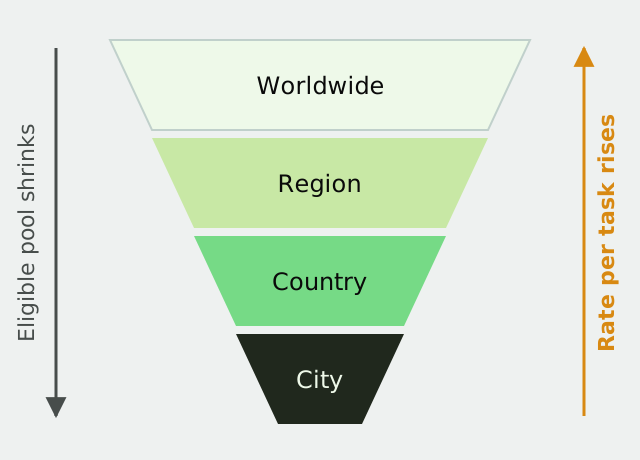
The eligible pool shrinks, so the reward has to rise for the campaign to fill. A rate that clears easily on an open global brief will sit half-filled on one limited to a single city.
Competition for each spot falls sharply, which is why workers should prefer restricted briefs. An open task competes with everyone; a brief needing Dutch speakers in the Netherlands competes within a few hundred people, and pays better for exactly that reason.
Result quality rises, because the people taking it can actually answer the question. This is the part that justifies the higher rate. Forty answers from the right market are worth more than four hundred from anywhere.
Roughly, expect to add 25% to 75% for a national restriction on top of a language requirement, and more for a single city in a smaller market. That is not a surcharge, it is the price of a scarcer input, and it is reflected in what the payout looks like at the other end.
When a campaign will not fill
Coverage is an empirical question and no platform can conjure a population that is not there.
Dense urban areas in large markets fill quickly at ordinary rates. Smaller towns fill slowly and need a premium to cover travel where the task is physical. Genuinely remote locations may not fill at any rate.
Two ways to design around it. Tier the campaign so partial coverage is still useful — twenty urban sites as the core sample, rural sites as opportunistic — rather than a design that produces nothing until all forty fill. And pilot before committing, because twenty spots in the hardest market tells you within days whether the full campaign is viable.
If a targeted campaign stalls, the fix is rarely patience. Widen the geography, raise the reward, or relax whichever requirement is doing the filtering, then relaunch.
For workers
Two things follow from all of the above, and they are the highest-return profile actions available to you.
Complete the country, city and language fields properly. Eligibility matching runs on structured fields, and a blank one reads as a disqualification rather than as a maybe. People routinely see a thin marketplace and conclude there is no work, when what they are seeing is the subset an incomplete profile qualifies for.
List every language you genuinely work in, at an honest level. Non-English work is chronically short of people and priced accordingly, and this is the single most undervalued thing on most profiles. Overstating it is the fastest route to a rejection you cannot appeal, so state the real level.
Worked examples
Four campaigns, and what the targeting decision should be in each.
Thirty short-form clips for paid social in the US
Target the US, because the setting and accent are part of what the ads are buying, and add English. Do not restrict by city, since nothing in the brief depends on one. This is the ordinary shape of creator work.
Checking a checkout against local payment methods in four markets
Target each of the four countries separately as four campaigns rather than one, because you want a comparable sample from each rather than whoever happens to answer first. Add the relevant language per campaign.
Structured feedback on a design from forty people
Leave it open unless the design is market-specific. You are buying a diverse sample of reactions and restricting it shrinks the pool for no gain.
Photographing shelf placement in twelve named cities
Target by city, one campaign per city, and pay a premium in the smaller ones. Require a photograph with the price label legible plus the store name, because the targeting establishes who can take it and the proof establishes what they found.
The pattern across all four: restrict where the answer depends on place, and split into separate campaigns wherever you want a comparable sample from each market rather than an aggregate.
Regions, and why they are blunt
Region targeting — Europe, Latin America, Southeast Asia — is available and it is usually the wrong tool.
A region is not a market. Payment methods, address formats, regulatory requirements and cultural references differ enormously within any of them, so a campaign targeting "Europe" to test a checkout returns results you cannot attribute and cannot act on.
Regions are useful for one thing: filling a campaign where the answer genuinely does not depend on the specific country but you want to exclude most of the world for time zone or language reasons. Content briefs in a shared language are the common case.
If the answer varies by country, target countries. If it varies by city, target cities and accept the smaller pool.
What targeting does not do
It does not verify that somebody performed the task in the stated place. Eligibility establishes that the worker's verified profile matches the requirement; the proof requirement establishes what they actually did. How a profile comes to be verified in the first place, and what that verification does and does not assert, sits with trust and compliance rather than with targeting. Those are two separate mechanisms and a campaign depending on location should use both — specify proof that carries the evidence, such as a photograph with the required detail in frame.
It also does not substitute for a clear brief.
A perfectly targeted campaign with an ambiguous question returns forty ambiguous answers from exactly the right country.
Time zones, which people forget
Geography carries a scheduling consequence that surprises posters running their first international campaign.
Asynchronous work: it helps
A brief published at the end of your working day is picked up overnight in markets several hours ahead, and submissions are waiting when you return. Teams frequently discover their fastest turnaround comes from the market furthest away.
Live participation: it constrains
A campaign needing a response within four hours during your business day excludes most of the people in a market eight hours out, and the brief will underfill for a reason that looks like poor supply.
Two practical adjustments. State deadlines in a way that does not assume a time zone — hours from reservation rather than a clock time — and widen the window on any campaign targeting markets far from you. Both cost nothing and both materially improve fill rates.
A sensible default
Start open unless you can name the reason location changes the answer: local pricing, market-specific rendering, cultural judgement, accent and setting, or regulatory context. When you can name it, restrict tightly and pay for it rather than restricting loosely and hoping.
Then pilot in the hardest market first. If the awkward one fills, the rest will.