"Fiverr alternative" is searched by two groups who want opposite things, which is why most articles answering it are useless. Buyers want somewhere the quality is easier to judge. Sellers want somewhere the commission is lower and the competition is thinner.
The useful sort is by reason for leaving. There are four, and each points somewhere different.
Why people actually leave
The fees
Both sides pay. The seller gives up a commission on every order and the buyer pays a service charge on top of the listed price, so the number on the listing is not what either party experiences. This is normal across the category rather than unique to Fiverr, and the fix is comparing totals rather than headline rates.
The race to the bottom
At the entry level the format rewards whoever will do it cheapest, and there is always somebody cheaper. Sellers feel this as a ceiling they cannot break through. Buyers feel it as a marketplace where the cheap option is genuinely bad and the good option costs about what an agency would.
The format
A gig is a packaged, priced, repeatable unit. That is elegant for a logo and awkward for anything with an unknown scope, and it is entirely wrong for a job that needs to be done forty times by forty different people.
The visibility problem
Sellers depend on an internal ranking nobody outside the company can see or predict. Buyers see listings optimised for that ranking rather than sorted by quality, which makes choosing hard.
For buyers: match the alternative to the job
Larger projects with unclear scope
General freelance platforms handle this better than gig platforms because the unit is a contract rather than a package. You post a brief, receive proposals, interview, and agree hourly or milestone terms.
Upwork, PeoplePerHour, Freelancer.com and Guru all work this way. Expect proposals of wildly varying quality and expect to spend real time filtering, which is the actual cost of this route.
Specialist or high-stakes creative work
Curated networks vet before listing. Toptal for engineering and finance, Contra for design and creative, Dribbble's hiring side for visual work, and various invitation-only design networks.
Fewer options, higher rates, considerably less filtering. Worth it when a bad hire costs more than the premium.
One well-defined deliverable
If you know exactly what you want and it is a standard thing — a logo, a video edit, a translation — the gig format is genuinely good at this, and Fiverr's competitors in that shape are largely similar. Switching platforms will not change much. Writing a better brief will.
The same small job, many times over
This is the case none of the above serve, and it is the one people usually describe badly.
You do not want to hire one person. You want forty people in six countries each to complete the same twenty-minute job — test a signup flow, film a short clip, check a listing renders correctly locally, give structured feedback on a design. Hiring forty freelancers individually is absurd, and a gig platform has no concept for it.
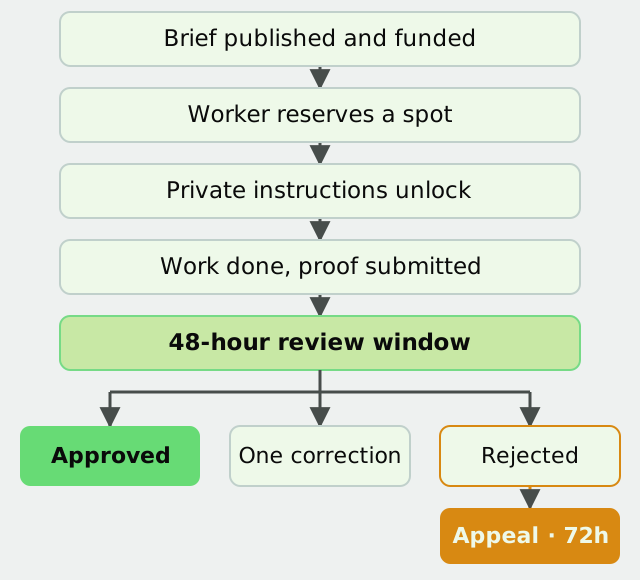
That is a task marketplace rather than a freelance marketplace. You publish one brief with a rate per person and a number of spots, fund it, and eligible workers reserve individual spots. Brief Buck works this way: you set the rate rather than accepting a platform rate card, target by country, city or language, and specify what proof each person must submit. Private instructions stay hidden until somebody reserves, so campaign details are not sitting in a public listing.
The trade is honest — this is not the tool for hiring a designer for three weeks. It is the tool for the shape of work gig platforms cannot express.
For sellers: what changes and what does not
Moving platform does not fix the rate. If you sell commodity work, every marketplace has the same downward pressure, because the buyer's alternative is always somebody cheaper. What changes the rate is specialising until the comparison stops being like-for-like.
For the equivalent question about hourly contract platforms, Upwork alternatives applies the same sorting to a market where the unit is billed time rather than a packaged deliverable.
Direct clients pay considerably more than any platform. No commission, no ranking, no competition on the page. The cost is doing your own outreach, which is uncomfortable, which is exactly why the rate holds. Most freelancers earning well use platforms for discovery and direct relationships for income.
Check what a platform charges on both sides. A lower seller commission paired with a higher buyer fee often means fewer buyers, which is worse for you than the commission was.
Bidding platforms have a hidden cost. Where you pay for the right to submit proposals, factor that in. Twenty unsuccessful proposals is a real expense against nothing.
Content and task work sit outside this entirely. If what you actually sell is short video, structured feedback or small verifiable jobs, freelance platforms are the wrong venue. What creator content pays and how usage rights change it is a different market with better rates and much less competition.
The categories of alternative, in plain terms
Naming the categories helps more than naming platforms, because platforms come and go and the categories do not.
General freelance marketplaces. Open posting, proposals, contracts, escrow. Upwork, PeoplePerHour, Freelancer.com, Guru. Best for substantial work with one person. Worst for anything small, because the contract overhead swamps the job.
Gig and packaged-deliverable platforms. Fixed scopes at listed prices. Fiverr itself and its direct competitors. Efficient for standard deliverables, awkward for anything with unknown scope.
Vetted and curated networks. Screening before listing, higher rates, small candidate pools. Toptal, Contra, various invitation-only design and engineering collectives. Best where a bad hire is expensive.
Category specialists. Platforms built for one type of work — design contests, translation marketplaces, video editing services, voiceover networks. Better matching within their niche than any generalist manages, and useless outside it.
Task and campaign marketplaces. One brief executed many times by many people, with proof attached. Brief Buck sits here. The unit is a task rather than a hire, which is the distinction that makes it a different category rather than a cheaper version of the same thing.
Direct hiring. No platform. Outreach, a contract, an invoice. Highest rates for the freelancer, lowest total cost for the client, and all of the sourcing work falls on whoever initiates it.
Most people searching for an alternative are in the wrong category rather than on the wrong platform within the right one, which is why switching so often disappoints.
Comparing platforms honestly
Fee structures change often enough that any specific percentage in an article is unreliable within a year. Check the current numbers yourself, and check these five things while you are there.
Total cost, both sides. What a buyer pays in full, and what a seller receives after everything. Compare those two numbers across platforms and ignore the marketing.
When the money is committed. Is the buyer's payment held before work starts? Funded up front means a seller is not extending credit to a stranger. This matters far more on small jobs than on large ones.
What happens in a dispute. Who decides, how long it takes, and whether there is any route to challenge a rejection. A platform where a buyer's refusal is final and unexplained puts the whole risk of an opinion on the person who did the work.
How many revisions are included. One correction with a deadline is reasonable. Unlimited revisions turn a fixed price into an open-ended commitment.
Whether the work format fits. The most common mistake is choosing a platform on price and then discovering it cannot express the job you have.
Try this before switching
Platform-switching is often displacement activity, and the same problem follows you. Two things are worth trying first because they cost an afternoon.
Sellers: narrow the offer until it is boring
The most common cause of a stalled gig is that it competes with ten thousand identical ones. "Video editing" competes with everybody. "Short-form editing for supplement brands, vertical, three hook variants" competes with almost nobody, and the buyer searching for exactly that will pay more for it. Narrowing feels like shrinking the market and it is how the rate goes up.
Buyers: fix the brief before you fix the venue
Most disappointing marketplace work traces to a brief that did not say what success looked like. State the deliverable, the format, the deadline, the number of revisions included, and one example of something you consider good. Sellers self-select on clarity, and the competent ones decline vague briefs rather than bidding on them and hoping.
If either of those fixes the problem, you have saved yourself a cold start somewhere new.
A worked comparison
The abstract version of the fee argument is unconvincing, so here is a concrete one.
Say you need thirty short product clips filmed by thirty different people in three countries.
Through a gig platform. You find and brief thirty sellers individually. Each order carries a listed price plus a buyer fee, and each needs its own message thread, its own brief, its own revision cycle. The platform cost is one line; the real cost is thirty separate coordination efforts, and the variance between thirty separately negotiated results is high.
Through a general freelance platform. You could hire one person to source and manage the other twenty-nine, which adds a management layer and a markup, or you could run thirty contracts, which nobody does twice.
Through a task marketplace. One brief, a rate per person, thirty spots, funded once. Workers reserve individual spots and submit against the same requirements, so the thirty results are comparable rather than thirty separate negotiations. Country targeting handles the three markets in the same brief.
The fee percentage is not what separates these. The coordination cost is, and it is the number nobody puts in a comparison table.
A short decision path
Hiring one person for a substantial project? A general freelance platform, and budget real time for filtering proposals.
Hiring one person for something high-stakes? A vetted network, and pay the premium.
Buying one standard deliverable? The gig format is fine. Write a better brief rather than switching.
Needing the same small job done many times, possibly in specific countries? A task marketplace. This is the gap in the category and it is why the general platforms feel wrong for it.
Selling, and unhappy with the rate? The platform is probably not the problem. Specialise, or move toward direct clients, or move into work that is not sold on gig marketplaces at all.
One thing to check on any platform you try
Whatever you land on, run one small job through it end to end before committing anything real.
As a buyer, that means posting one genuine small task, funding it, receiving the work and completing the review. You learn how long each stage takes, how the dispute path behaves, and whether the interface fights you — all while the money at risk is trivial.
As a seller, it means completing one small job and taking the payment all the way through to a withdrawal in your own bank account. That last step is the one people skip, and it is where the surprises live: conversion rates, withdrawal minimums, verification requirements that turn out to be impossible from your country.
An afternoon spent on that saves the much worse discovery of finding out during a job that matters.
What no alternative fixes
Worth saying plainly, because a lot of platform-switching is displacement activity.
A vague brief produces bad work everywhere. Marketplaces cannot compensate for a buyer who has not decided what they want, and the revision cycle that follows is usually blamed on the seller.
Commodity work is priced by competition, not by platform. If ten thousand people can do what you sell, no marketplace will protect your rate.