Research participant recruitment is the process of finding, screening and enrolling people who match a study. It covers academic research, product and user research, and market research recruitment; the approval, consent and safeguarding requirements are not identical across those settings.
Every recruitment quote you receive is mostly one number wearing different clothes: what proportion of the population qualifies for your study.
That number is called incidence rate, and it decides cost, timeline and feasibility. Understanding it makes quotes predictable and stops you designing studies nobody can fill.
What it costs
| Participant type | Recruitment fee | Plus incentive |
|---|---|---|
| General consumer | $25 – $80 | $50 – $150 |
| Narrow consumer profile | $80 – $200 | $75 – $200 |
| Small business owner | $120 – $300 | $150 – $300 |
| Professional or specialist | $150 – $400 | $200 – $500 |
| Senior decision maker | $300 – $600 | $400 – $1,000 |
| Clinical or highly regulated | $400 – $900 | $500 – $1,500 |
The recruitment fee pays whoever finds and schedules the person. The incentive is what the participant receives. Quotes that present one number are usually combining them, and it is worth asking which is which, because the incentive is where you have some discretion and the fee generally is not.
Incidence rate, and why it dominates
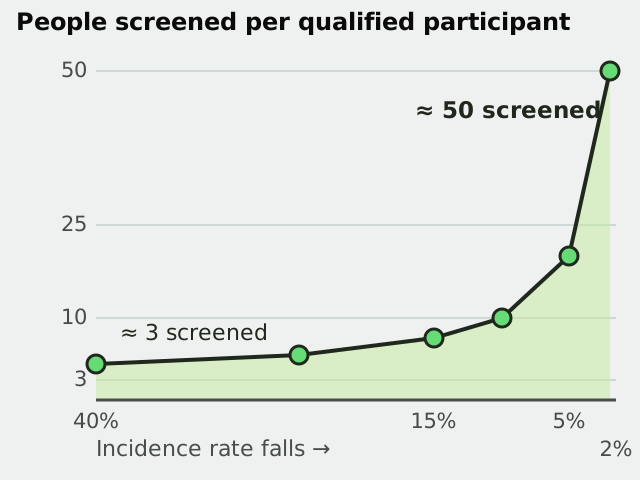
If 40% of the general population qualifies for your study, a recruiter screens roughly three people to find one. If 2% qualify, they screen fifty. All that screening is unpaid work for the respondents and paid work for the recruiter, and the cost lands in your quote.
This explains several things that otherwise look arbitrary. Why adding one apparently small criterion doubles the price. Why "people who use our product" costs far more than "people in this age range". Why professional studies cost several times consumer ones even when the session is identical.
It also gives you a lever. Before accepting a quote, look at your screening criteria and ask which ones genuinely change the answers you will get. Teams routinely specify age ranges, income bands and geographies that feel rigorous and do not affect the findings, and each one cuts incidence.
A useful exercise: rank your criteria by how much you would regret dropping them. Everything below the top four is usually negotiable, and dropping two of them frequently halves both cost and timeline.
The three sourcing routes
Panels hold pre-recruited people who have agreed to be contacted. Fast, cost-effective at consumer scale, and the standard route for anything with reasonable incidence. The limitation is that a panel can only offer you people who joined a panel, which is a specific and self-selecting group.
Specialist recruiters find people who are not in panels — a cardiologist who prescribes a particular class of drug, a facilities manager at a company above a certain size. Slow and expensive, and often the only way to reach a professional population.
Direct sourcing means finding participants through your own channels, a client list, or a targeted campaign. Cheapest per participant and the most work, and it reaches people no panel holds. It also carries a bias risk worth naming: people recruited from your own customers are not representative of people who did not become customers.
Most studies use one route. Studies with mixed audiences frequently need two, and budgeting for a single route on a study that needs both is a common way to run out of money mid-fieldwork.
The professional participant problem
Anyone who has run consumer research has met somebody who is very good at qualifying for studies. They know the screening patterns, they claim the behaviours that get them through, and they are articulate in a way that reflects practice rather than the population.
They are a real threat to data quality and a difficult one to eliminate, because the people most willing to spend ninety minutes talking about yoghurt are systematically unlike the people who are not.
What actually helps: screen on recent participation and exclude anybody who has done a study in your category within a defined window. Ask open questions instead of multiple choice where you can, because a list of options tells a practised respondent which answer to pick. Verify at least one criterion against something external where the study warrants it. And treat any panel that cannot describe its exclusion policy as selling you a habituated sample.
Complete elimination is not achievable. Reducing it to a small share is, and it changes what the findings are worth.
Feasibility before commitment
The single most useful thing to ask a recruiter, before any quote, is whether the study is feasible at all.
A good answer covers the estimated incidence, the expected timeline, the markets where it will be hard, and what would have to change if it does not fill.
A recruiter who quotes a price without discussing feasibility is quoting an intention rather than a plan.
The distinction matters most where the population you are asking for is thin.
Where a task marketplace fits
For a narrower band than a panel or a specialist recruiter covers, and at lower overhead.
It suits studies where you need people in specific countries or cities, where the criteria are checkable rather than deeply specialised, and where the output is a structured task or an unmoderated session rather than a scheduled interview. Also for piloting — running twenty short sessions cheaply to find out whether the questions work before commissioning a full study. Where the profile is a senior professional and the format is a scheduled conversation rather than a task, what an expert network charges and screens for is the honest comparison. And where the study is measuring whether a campaign shifted anything, how brand lift studies are designed and where they fail covers the sample sizes that claim needs. For continuous feedback rather than a one-off study, what a voice of the customer programme can and cannot hear sets out which populations your own channels never reach, and how to set the incentive itself covers the number that decides whether a study fills evenly.
On Brief Buck you publish one brief with the reward and the number of spots, target by country, city or language, and specify exactly what each participant submits. Eligibility is checked before somebody reserves rather than after they deliver, funding is committed before the brief publishes, and review runs on a fixed clock.
Screener design, briefly
The screener is where most recruitment quality is won or lost, and it is usually written last and quickly.
Ask about behaviour rather than intention. "How many times have you bought X in the past three months" filters better than "do you buy X regularly", because the first has an answer somebody either has or does not.
Bury the qualifying criterion among non-qualifying ones. A screener where question three obviously decides eligibility teaches a practised respondent exactly what to say, and they will.
Avoid leading options. Listing the answers you want among a set of implausible ones is an invitation.
Include at least one consistency check — the same fact asked differently, several questions apart. Contradictions are the cheapest signal you have.
Keep it short. A twenty-question screener for a study that pays $75 loses people who would have qualified, and the ones who persist skew toward the incentive-motivated.
Designing so recruitment is cheaper
Four decisions made before you brief a recruiter change the price more than negotiating does.
Widen geography where the answer does not depend on place. A national study costs less than a three-city one for the same sample size.
Allow asynchronous participation where the method permits. Scheduled sessions require calendar coordination, which is a real cost and a real drop-out source; unmoderated tasks do not.
Reduce the session length. Incentives scale with time, and a forty-five minute session frequently gathers what a ninety-minute one does, minus the part where attention degrades.
Run fewer, better sessions. Five participants per distinct group finds most of what is findable in usability work. Recruiting twenty because the budget allowed it is usually paying to confirm what the first five showed.
Incentives, and setting them right
The incentive is the part you control, and both extremes cost you.
Set too low
The study underfills, or fills with people whose time is worth less than you assumed, which is a sampling problem rather than a saving.
Set too high
You attract people motivated primarily by the payment, which is the professional-participant problem arriving through the front door.
Reasonable anchors: general consumer sessions of sixty minutes at $75 to $125; narrow consumer profiles at $100 to $200; professionals at $200 to $500 an hour of their time, scaling with seniority. Diary studies and anything spanning weeks should be paid at completion rather than up front, with a partial payment for partial completion so people who drop out at week two are not stiffed entirely.
Pay promptly and say when you will. Slow incentive payment is the most common complaint participants have, it damages a panel's ability to recruit for you again, and it costs nothing to get right.
One thing worth avoiding: paying in points, credits or vouchers where cash is possible. It reduces the real value of the incentive, and participants notice.
Ethics that matter practically
Beyond being right, these affect data quality directly.
Tell participants what the study is about in general terms, what will happen to the recording, and who will see it. People behave differently when they suspect they are being misled about the purpose, and consent obtained vaguely produces guarded answers.
Let people withdraw. A participant who feels trapped in a ninety-minute session gives you compliance rather than opinion.
Handle recordings carefully. Sessions frequently contain identifiable detail participants did not intend to share, and a research recording is personal data in most jurisdictions.
Be careful with vulnerable groups, health topics and anything involving children. Those studies need ethical review rather than just a screener, and a recruiter who does not raise it is not the right supplier.
A sensible sequence
Write the screening criteria
Every condition a participant has to meet, listed before anybody is contacted.
Rank them by regret
Order the criteria by how much you would mind dropping each one. Everything below the top four is usually negotiable.
Ask for a feasibility read, not a quote
Send the top four to a recruiter and find out whether the study can fill at all before discussing price.
Pilot with a small number
Most of what a first round teaches you is about your own questions rather than about the market.
Scale
With criteria you have already tested rather than criteria you assumed.