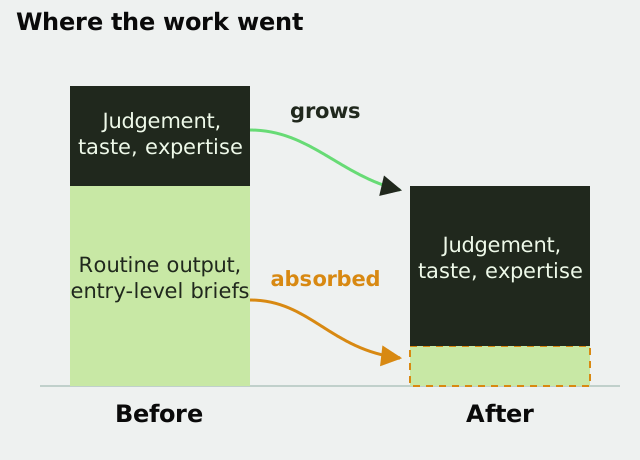
Voice work split in half over the last few years, and the halves are moving in opposite directions.
Generic narration — the neutral read of a script nobody will scrutinise — is being generated. Rates for that work fell and the volume fell with them. What sits above it, where somebody needs a performance, a direction, a contract, or a person whose consent is documented, is holding and in places paying more than it did. Anyone entering now should aim at the second half deliberately, because the first is not a ladder to it. Long-form narration works differently enough to be its own trade — what audiobook work pays and what it costs in hours.
What it pays
| Work | Rate |
|---|---|
| E-learning and corporate narration | $150 – $400 per finished hour |
| Explainer and corporate video | $150 – $500 per script |
| Regional radio commercial | $250 – $800 plus usage |
| National broadcast commercial | $1,500 – $10,000 plus usage |
| Audiobook | $100 – $400 per finished hour |
| Video game and character work | $200 – $800 per session |
| IVR and phone systems | $100 – $300 per project |
| Podcast intros and imaging | $75 – $300 |
Two of those rows need translating.
A finished hour
One hour of the listener's experience, which takes three to six hours to record, edit and proof — so $200 per finished hour is closer to $40 to $60 an actual hour before you are fast.
Usage is separate money
The session fee pays for the recording; usage pays for where it runs and for how long. A regional advert for six months and a national campaign in perpetuity are the same forty minutes of your time at wildly different prices. Quoting one number for both is the most expensive beginner mistake in this field.
What changed
Synthetic voices are now adequate for anything where nobody is listening critically. Internal training modules, phone menus, machine-read documentation, low-stakes filler. Those jobs are largely gone at any rate a person would accept, and pretending otherwise wastes a year.
What they have not absorbed divides into four groups.
Performance work, where the read carries character, timing and emotional shading that a director will iterate on live. Anything with a director in the session is safe for now, because the value is the responsiveness.
Accountability work, where a real person's identity is contractually attached. Regulated advertising, medical content, anything where a company needs to say who recorded it.
Brand-voice work, where a specific human voice is the asset and has been for years. Replacing it is a brand decision rather than a cost decision.
And, newly, consent and licensing work. Some voice actors now license a synthetic version of their own voice under contract, with terms about where it may be used. That is a new revenue line and it needs careful reading — a broad licence signed once can compete with you afterwards.
The setup, in the right order
The room matters more than the microphone, and almost everyone gets this backwards.
Buyers reject recordings for room echo and background noise far more often than for microphone quality. A treated wardrobe with clothes on both sides and a $150 large-diaphragm condenser produces broadcast-usable audio. An untreated spare room with a $900 microphone produces a recording with the room in it, and no amount of processing removes that convincingly.
Treat a small space
Use what you own — a wardrobe, clothes on both sides, anything that stops the walls answering back.
Buy a microphone and an interface
Around $250 together, which is where the useful spending stops.
Add headphones for monitoring
So you hear what the file contains rather than what the room sounds like.
Install editing software
The free options are entirely sufficient.
What not to buy early: a vocal booth, a high-end preamp, a plugin bundle, or a course promising to make your voice marketable. The equipment ceiling in this field is reached much sooner than people expect.
Demos, which are the whole application
Nobody is hired on a voice. They are hired on a demo, and a demo is a specific artefact rather than a recording of you reading something.
Make one per category you want work in. A commercial demo is sixty to ninety seconds of several short pieces, each in a different style, cut tight with no dead air. An e-learning demo is a single ninety-second stretch demonstrating that you can be clear and warm for a long time without becoming monotonous. A character demo is distinct voices, held for long enough to prove they are stable.
Three rules. Lead with your strongest four seconds, because that is what gets heard. Only include what you can reproduce on demand, since being booked for a voice you cannot repeat is worse than not being booked. And do not include categories you are not pursuing — a demo spanning everything reads as somebody without a specialism.
Home-made demos are normal at the start. Professionally produced ones sound better and are worth the money once you know which category you are in, which is usually after the first few bookings rather than before.
Where the work is
Casting marketplaces are the standard entry, where clients post jobs and performers audition. High competition, transparent rates, and a subscription in some cases. Reasonable for building credits and rarely where anyone stays.
Agencies represent performers and put them forward for higher-paid work. They take a percentage and they are selective, and getting signed usually needs credits already.
Production companies, e-learning developers, agencies and studios book directly. This pays best and requires you to find them, which is why most people never do.
Marketplaces that distribute one brief widely carry shorter audio work — a script read, a pronunciation sample, a localised recording, a short brand piece. Smaller units, faster turnaround, and useful for filling weeks when nothing larger is booked.
The pattern that works is the same as in every adjacent field: marketplaces for credits, direct relationships for income.
The language advantage
Underused, and the largest single lever available to anyone who has it.
Non-English voice work is short of people in almost every market, and the shortage is severe outside the major European languages. A native speaker of a language with a small professional pool can charge well above the general rates above, and face a fraction of the competition.
Accent work within English is the same idea. Regional British, Australian, South African, Irish, and specific American regional accents are all requested and all thin on supply. Genuine command of one is a marketable specialism; an approximation is a rejection.
If you work in more than one language, say so prominently and record a demo in each. Bilingual performers get booked for projects monolingual ones never see.
Quoting a job properly
Most voice work is quoted per project rather than per hour, and the quote has three components people routinely collapse into one.
The session fee covers your time recording and the basic edit. For a short script that is often a minimum charge rather than a calculation, because a two-minute read still costs you the setup, the recording and the cleanup.
Usage covers where it runs and for how long, the same variable that prices creator content in the adjacent market. Internal training material used inside one company is the cheapest. Regional advertising for a defined term costs several times that. National broadcast in perpetuity costs multiples again, and perpetuity should be resisted or priced as though the client will use it forever, because they will.
Revisions should be capped in the quote. One round of pickups for script changes is normal and expected. Unlimited rerecording because a client keeps rewriting is how a $300 job becomes a week.
A useful habit: quote the session fee and the usage as separate lines even when you give a single total. It makes the licence visible as a priced item, and it makes a later expansion of usage a conversation about money rather than an assumption.
Auditioning without wasting your week
Casting marketplaces run on auditions, and the ratio is brutal enough that how you audition matters more than how you read.
Read the specification before the script. Most auditions are discarded for the wrong accent, the wrong age range or the wrong gender, which are stated and ignored.
Record the first thirty seconds well rather than the whole thing adequately. Casting directors stop early, and a two-minute audition where the good part arrives at ninety seconds is not heard.
Match the reference if one is supplied. Clients providing a reference read want that, not your interpretation of it, and creative deviation at audition stage reads as somebody who will be difficult to direct.
Do not audition for everything. Twenty targeted auditions in your actual range beat a hundred scattered ones, and the scattered hundred cost a week.
What separates people who last
Reliability again, as everywhere. Delivering on the day, in the specified format, at the specified levels, with the file named as requested. Technical sloppiness — inconsistent levels, wrong sample rate, audible mouth noise — costs more bookings than an average read does.
Self-direction, because most work now is recorded alone from a written brief. Reading a brief and inferring the tone it wants is the actual skill in unmanaged work.
And retakes without friction. Clients expect a pickup session for changed script lines, and performers who make that easy get rebooked.
Protecting your voice, contractually
New and worth reading carefully, because the terms are moving faster than most performers' contracts.
Some agreements now include clauses permitting synthetic reproduction of your voice from the recordings you deliver. Occasionally that is explicit and priced. Sometimes it sits inside a broad grant of rights that reads like standard boilerplate.
Three things to look for before signing anything. Whether the contract permits creating a synthetic model from your recording, which is different from using the recording. Whether any such use is limited by term, territory and purpose, or is open-ended. And whether you can revoke it, which most such clauses do not allow.
Licensing your voice deliberately can be an income line in its own right, and it should be a separate negotiation with its own fee, not a clause inside a session agreement for a $300 read.
Where a contract is unclear, ask directly and get the answer in writing. A client with legitimate intentions will answer plainly.
Whether to start now
Worth starting
If you are aiming at performance, character, commercial or a language other than English, and if you can treat a small room and produce three demos before applying to anything.
Not worth starting
If the plan is generic narration at volume, because that is the half being absorbed and the rate is falling underneath you.
The honest timeline is three to six months of applying before consistent bookings, which is longer than most adjacent work. For something that pays in weeks rather than months while that builds, what home side work returns per hour sets the faster options against each other.