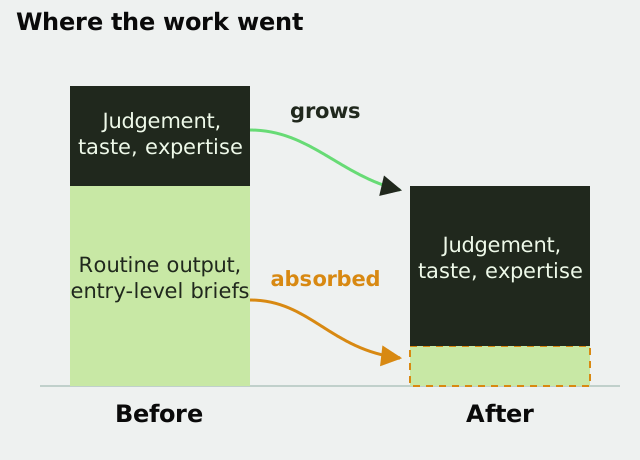
Machine translation did to this field what it did to transcription: it removed the floor and left the parts that need judgement.
General translation of undemanding text is largely gone as paid work. What is left is specialised, regulated, creative, or culturally difficult — plus an enormous volume of correcting machine output, which is a genuinely different job that barely existed fifteen years ago.
Total demand for language work rose. The composition of it changed completely.
What it pays
| Work | Rate |
|---|---|
| General translation, common pair | $0.06 – $0.12 per source word |
| General translation, rare pair | $0.15 – $0.35 per source word |
| Legal translation | $0.15 – $0.35 |
| Medical and pharmaceutical | $0.18 – $0.40 |
| Technical and engineering | $0.12 – $0.30 |
| Post-editing machine output | $0.03 – $0.08 |
| Transcreation and marketing | $50 – $150 per hour |
| Subtitling | $5 – $15 per video minute |
| Certified or sworn translation | $30 – $80 per page |
Per-word rates mislead unless you know your throughput. A competent translator handles 2,000 to 3,000 words a day in a familiar domain, considerably fewer in an unfamiliar one. At $0.10 that is $200 to $300 for a full day, which is the honest arithmetic behind an apparently small number.
Post-editing looks poor per word and frequently is not. The draft exists, so throughput can reach 6,000 to 8,000 words a day, and the hourly can match or beat general translation. Whether it does depends entirely on how good the machine draft is, which varies by pair and domain more than by anything else.
Which pairs pay
Rarity relative to demand, not difficulty, sets the rate.
Spanish, French and German into English are the most competed pairs in the industry and pay at the bottom of the general range. There are simply a lot of people who can do it.
Nordic languages, Dutch, Japanese, Korean, and less common European pairs pay considerably more, because the supply of people who can work professionally in them is small and the demand is real. Language work is the strongest case in the remote side hustle comparison, because the pool is small everywhere.
Pairs not involving English at all — German into Polish, Japanese into Spanish — are scarcer again and priced accordingly, though the volume is lower.
The specialisms
Legal work covers contracts, filings, corporate documents. Requires familiarity with both legal systems rather than just both languages, because a term with no equivalent needs a decision rather than a dictionary. Certification is frequently required.
Medical and pharmaceutical is the best paid and most regulated. Clinical documentation, trial materials, patient information, device instructions. Errors carry consequences beyond embarrassment, which is precisely why it resists automation.
Technical translation covers manuals, specifications, engineering documentation. Consistency of terminology matters more than elegance, and subject familiarity makes a translator several times faster.
Financial work is seasonal around reporting periods and pays well within them.
Transcreation is the odd one out. Marketing copy rewritten so it works in the target market rather than translated literally — a slogan that lands, a campaign that references something local, a tone that reads as native. Priced hourly because word counts are meaningless when the output may share nothing with the input. This is the category machine translation is furthest from touching, because the brief is essentially "write something new that does this job here".
Post-editing, in practice
The largest growth area, and worth understanding before accepting it.
You receive a machine-translated draft and correct it to a specified standard. There are usually two of them, and they pay differently — clients frequently ask for the second while quoting the first.
Light post-editing
Produces something accurate and comprehensible without polish.
Full post-editing
Produces something indistinguishable from human translation.
The skill is knowing when to fix and when to rewrite. Machine output is often 80% acceptable and confidently wrong in the remaining 20%, and the errors cluster in predictable places: terminology, ambiguous pronouns, register, idiom, and anything requiring knowledge outside the sentence.
Getting started
Tests rather than credentials, for most commercial work.
Pass the test
Agencies and platforms gate assignments behind a translation test, and the result sets both your access and your rate. Take them seriously, read the style guide fully first, and do them when you are fresh rather than at the end of a day.
Specialise early
A generalist competes with everyone in the pair; somebody who does medical device documentation in one pair competes with a handful of people and is asked back. Prior employment in any field is a qualification here — a former nurse, engineer or accountant has a genuine advantage that no linguistics degree substitutes for.
Learn a computer-assisted translation tool
Agencies expect it, and translation memory means you are paid for repeated segments once but work on them once too, which raises your effective rate on long documents rather than lowering it.
Get certified where your market requires it
Do it before pursuing legal or sworn work rather than after being turned down.
Where the work is posted
Translation agencies are the largest employer of freelance translators and rarely advertise beyond their own vendor registration forms. Applying directly to a list of agencies in your specialism is unglamorous and it is how most working translators fill their capacity.
Platforms and marketplaces are faster to start and pay less, with heavy competition on common pairs. Useful for first credits.
Direct clients pay the most and require you to find them. Law firms, manufacturers, medical device companies and marketing agencies all buy translation continuously and most have no permanent arrangement.
Task marketplaces carry shorter language work — checking whether a translation reads naturally, localising a short piece of copy, verifying that content is appropriate for a market. Small units, and the closest thing to on-demand language work. Campaigns of that kind are usually targeted at a named country or language, which is what keeps the applicant pool small.
Rates, and holding them
Translation has an unusual pricing culture: agencies frequently ask for your rate rather than offering one, which puts new translators in the position of guessing.
Quote per source word for prose, because it is countable before the work starts and it protects you against a target language that expands. Quote hourly for editing, proofreading, transcreation and anything where the word count does not describe the effort — the same argument freelance writers make for per-project pricing.
Set a minimum charge. A 120-word document still costs you the email, the file handling, the terminology check and the delivery, and translators who bill purely per word lose money on every small job.
Expect downward pressure and decide in advance where you stop. Agencies negotiate, volumes are dangled, and the rate you accept on a first project becomes your rate with that client indefinitely. Being unavailable at a rate is a complete answer.
Raise on specialism rather than on tenure. Adding a domain moves you a band; another year of general work does not.
Working with agencies
Most freelance translators get most of their work through agencies, and the relationship has its own rhythm worth knowing.
Vendor registration is a form, a test and a rate negotiation, usually in that order, and it can take weeks before a first job arrives. Registering with fifteen agencies over a month is normal and it is what produces steady volume six months later.
Project managers assign work to whoever answers first among the people who fit. Availability responsiveness matters as much as quality for getting assigned, which frustrates good translators and is simply how the queue works.
Deadlines are usually set by the agency's own commitment to the end client, so they are less negotiable than they look. Ask for the real deadline rather than assuming padding exists.
Payment terms of thirty to sixty days are standard, which means your first agency payment may arrive two months after you start. Plan the first quarter around that rather than being surprised by it.
Subtitling and localisation, briefly
Adjacent work that draws on the same skills and is bought differently.
Subtitling is priced per video minute rather than per word, and it carries constraints translation does not: reading speed limits, character counts per line, and timing to the cut. A perfectly accurate subtitle that nobody can read in the time available is a failed subtitle, which means the job is partly compression.
Localisation goes further than either. Adapting software, a game or a product for a market — text, formats, currencies, imagery, sometimes features. It usually needs technical familiarity with the file formats involved, and it pays accordingly.
Both are consistently short of people outside the major pairs, and both are natural next steps for a translator who wants to move up from general prose work.
The judgement machines cannot make
Worth naming, because it is what the remaining rates rest on.
Translation is a series of decisions with no correct answer. A pun that does not carry. A formality distinction the target language forces you to make when the source did not. A cultural reference that means nothing locally. A term of art with no equivalent. A sentence that is deliberately ambiguous and must stay so.
Each requires knowing what the text is for and who will read it, and choosing. Machine translation produces a plausible option and no awareness that a decision was made. Catching those is the professional skill, and it is why post-editing pays anything at all rather than being automated in turn.
For adjacent work using the same abilities, country-targeted digital tasks explains why native-language feedback, local website checks and market-specific reactions command a premium when the eligible pool is small.
For anybody whose second language is also a usable recording voice, what voice-over work pays covers a market where non-English demand is chronically underserved.