Two things are true about freelance writing in 2026 and most advice picks one and ignores the other.
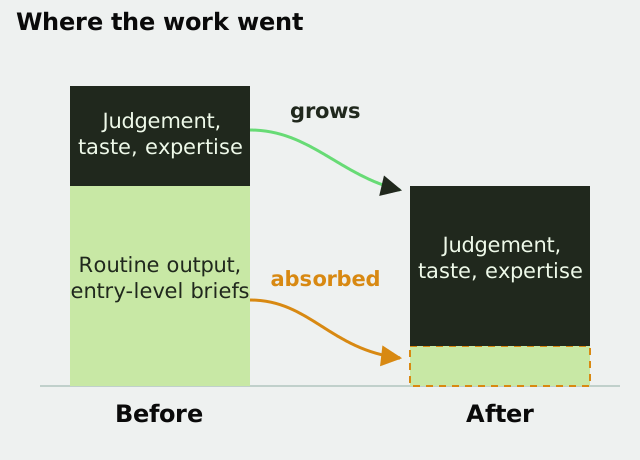
The bottom of the market has collapsed. Generic listicles, product descriptions, SEO filler at three cents a word — that work has been absorbed, and no amount of hustle will restore it.
The top of the market is fine. Writing that needs subject knowledge, an interview, a named author who can be held responsible, or a voice a company cannot generate has held its rate and in places increased it. There are fewer people doing it than there were, because the collapse at the bottom convinced a lot of writers the whole thing was over.
Which half you end up in is a choice about niche, made in the first week.
What it pays
| Type of work | Rate | Realistic hourly |
|---|---|---|
| General blog content | $0.03 – $0.10/word | $10 – $25 |
| Niche blog content with expertise | $0.15 – $0.40/word | $40 – $80 |
| Technical documentation | $0.30 – $0.80/word | $50 – $100 |
| Case studies with interviews | $600 – $2,500 each | $60 – $120 |
| Email sequences | $300 – $1,500 per sequence | $50 – $150 |
| Regulated content (finance, medical, legal) | $0.40 – $1.50/word | $70 – $150 |
| Ghostwriting for executives | $500 – $3,000 per piece | $60 – $200 |
That is the argument for niching, stated in money rather than in principle.
What AI actually changed
Worth being precise, because the panic and the dismissal are both wrong.
Gone or going
Generic informational content, product descriptions at volume, basic summarisation, filler written to hit a word count and a keyword. If a piece could be produced by someone who knows nothing about the subject after twenty minutes of searching, the market rate for it is now close to nothing.
Unaffected or improved
Anything requiring an interview with a real person, original data, professional accountability, regulatory review, or a named author whose reputation is attached. Also anything where a company's legal or compliance function has to sign off, because "a model wrote it" is not an acceptable answer in those rooms.
There is also work that did not exist before: editing and fact-checking machine drafts, which is tedious and paid. Companies producing large volumes need someone to catch the confident errors, and the rate for that sits between general writing and specialist writing. The same split runs through translation work, where machine output created a review market at the bottom and left certified work untouched at the top.
The practical read is short.
Stop competing on volume and speed, both of which are now free.
Compete instead on the things that cannot be generated — access to people, verifiable expertise, and being someone a business can hold responsible.
Picking a niche that pays
The instinct is to stay general so you can take any work. It is the single most expensive mistake in this job.
A generalist competes with everybody and is chosen on price. A specialist in one field competes with a handful of people and is chosen on fit. The specialist charges three times more for the same hour and spends less time pitching.
Niches that reliably pay:
- B2B software. High content budgets, complex products, and a constant need for people who can explain them. The most accessible well-paid niche for someone with any technical comfort.
- Finance and fintech. Regulated, which means accountable human authorship. Pays accordingly.
- Healthcare and medical. Highest rates, highest barrier. Credentials or demonstrable background usually required.
- Manufacturing and industrial. Unglamorous, chronically underserved, and clients are loyal because finding anyone who understands the subject is hard.
- Legal and compliance. Same logic as finance.
- Developer-facing documentation. If you can read code, this pays well and the pool is small.
Pick based on what you already know or can genuinely learn. Prior employment in a field is a qualification even if you never wrote in it, and a former nurse, accountant or engineer has a real advantage that no amount of writing skill substitutes for.
Getting the first client without clips
Nobody hires an unproven writer, and everyone starts unproven. The way through is the same as every other creative field: make the samples yourself.
Write three spec pieces in your niche
Not "here is what I could do" — actual finished articles of the type you want to be paid for. Around 1,200 words each. Publish them somewhere with a URL: a simple site, a professional network, anywhere a link works.
Make them specific
"Five tips for better marketing" proves nothing. "How mid-market logistics companies should handle carrier rate volatility in quarterly reporting" proves you understand a field, and that is the entire purchase.
Approach businesses directly
Find companies in your niche publishing weak content or none. Four sentences: what you noticed about their content, what you would write instead, your link, your rate. No attachment, no deck.
Reply rates run low. They are also the highest-paid route available, because there is no platform taking a cut and no other applicant on the page.
Job boards in parallel. Content-specific boards, general freelance platforms, and the careers pages of companies in your niche. Slower, lower-paid, but it fills the gap while direct outreach warms up.
Pricing
Charge per project, not per hour, and never per word if you can avoid it.
Per-word pricing punishes concision, which is the thing clients actually want. Per-hour pricing punishes getting faster. Per-project pricing rewards both and lets you keep the gains from your own improvement. Platform choice matters more than most writers expect; what to use instead of Fiverr works through the trade.
Work out your target hourly, estimate honestly, add thirty percent for revisions and the meeting nobody mentioned, and quote a single number.
Three notes on rates as a beginner:
Start around $0.15 a word or $250 a piece for niche content if you have spec samples. Below that you are competing in the collapsed half of the market.
Raise after every third client. Not by asking existing clients, but by quoting higher to new ones. The rate you set in month one has no claim on month six.
Price a rush properly. A 48-hour turnaround is worth a premium and costs you only the right to say no when already booked.
Where the work is posted
Four channels, and they pay very differently for the same skill.
Direct outreach. Highest rate, slowest start, no competition on the page. You find companies in your niche whose content is thin or absent and contact them. Reply rates sit in the low single digits, which sounds discouraging until you notice one reply from fifty at $600 a piece beats a month of board applications.
Content agencies and studios. They subcontract writing for their clients. Rates land fifteen to thirty percent below direct, and in exchange you never prospect. Once on a roster the volume can be steady for years. Approach the person who commissions writers rather than anyone in business development.
Job boards and freelance platforms. Slowest to pay well and easiest to start. Useful for the first two credits and rarely worth staying on once direct outreach warms up; the smaller platforms tend to have fewer applicants per listing than the two everyone names.
Your own publishing. Writing publicly in your niche generates inbound over months rather than weeks. It is the only channel that compounds, and the one everyone abandons in week three because nothing happens immediately.
Run direct outreach and one other simultaneously. Relying on boards alone is what produces the widespread belief that writing pays badly, because boards are where the collapsed half of the market lives.
A realistic first ninety days
Weeks 1–2
Choose the niche. Write and publish three spec pieces. Nothing earns yet, and this is the step most people skip by applying with nothing to show.
Weeks 3–6
Twenty direct approaches a week, plus applications to any board listing in your niche. Expect silence for the first fortnight. This is normal and it is not evidence about your writing.
Weeks 7–10
First paid piece, probably underpriced, probably from an unexpected direction. Deliver it early and clean, then ask directly what else is coming.
Weeks 11–13
Second and third clients arrive faster than the first, because a real credit changes how the next approach reads. Swap two spec pieces for real ones and raise the rate for anyone new.
Month one earns nothing for most people. Month three commonly lands between $300 and $900. The gradient after that depends almost entirely on whether repeat clients happened, which depends on delivery rather than prose.
Where writing sits against other side income
Freelance writing has the highest ceiling of the common home-based options and one of the slowest starts. Two to six weeks before a first payment is normal, and that assumes consistent outreach.
If money is needed sooner, the honest answer is to run something faster alongside it for the first month. Task and campaign work pays within days rather than weeks, which covers the gap while the writing pipeline fills. Short written feedback tasks and structured content briefs also overlap with the skill, so the hours are not wasted, and the same is true of paid transcription for anyone who types quickly.
The comparison that matters over a year: task work is flat, writing has a rate curve. A writer in month twelve earns several times what they earned in month one on the same hours. Very little else on the list does that.
Admin
Invoice properly from the first job. Numbered, dated, with payment terms stated. Net 30 is standard for business clients and worth putting in writing before you start rather than discovering after.
Get the scope in writing. Word count, deadline, number of revisions included, and who owns the work. Two rounds of revisions is standard; unlimited is how a $400 piece becomes a $60 one.
Keep records from the first payment. Tax is generally owed from the beginning rather than after a threshold. Set aside a share of each payment as it arrives.
Fitting it around a full-time job
Writing is more compatible with employment than most side work, and it fails in a specific way when it is not managed.
Check your contract first. Outside-work and exclusivity clauses are common in salaried roles. Most permit unrelated freelance work; some require notification; a few prohibit it. Writing publicly under your own name in your employer's industry is the case most likely to cause a problem, and it is worth resolving before a byline exists.
Never write about your employer's field using your employer's knowledge. Obvious in principle, easy to drift into, and the fastest route to a conflict conversation.
Protect the deadline, not the hours. Clients care when work arrives, not when you wrote it. That flexibility is the whole advantage of this over shift-based side work, and it disappears the moment you accept something needing daytime calls.
Take fewer commitments than you think you can manage. Two clients delivered reliably beats four delivered late. Late delivery is the only thing in this job that reliably loses a client, and overcommitment in month two is how it happens.
Write in one block, not in fragments. Most people produce more in a single uninterrupted two-hour session than in five scattered thirty-minute ones, because the reload cost on a piece of writing is high.
What separates the writers who stick
Nothing in this job rewards talent as directly as it rewards two duller things.
Reliability. Delivering on the day promised, in the format asked for, every time. Clients tolerate merely good writing from someone dependable and drop excellent writing from someone who disappears.
Reading the brief. Most rejected work missed a stated requirement rather than being badly written. Check the delivery against each line of the brief before sending.
Those two, plus a niche narrow enough that the client cannot easily replace you, is the whole formula. Everything else is refinement.