Transcription is the clearest example in online work of automation removing a floor rather than a ceiling.
Clean audio with one speaker is now transcribed adequately by software, and nobody pays a person to do it. What software still handles badly — overlapping speakers, strong accents, poor recordings, technical vocabulary, and anything where an error carries consequences — pays more than it did, because fewer people do it and the demand did not go away. If you would rather be reading aloud than typing, audiobook narration pays on a different basis entirely.
What it pays
Rates are quoted per audio hour, meaning one hour of recording, not one hour of your time. That distinction is the most important thing on this page.
| Work | Per audio hour | Realistic hourly |
|---|---|---|
| General transcription, entry | $15 – $30 | $5 – $15 |
| General transcription, experienced | $30 – $60 | $20 – $40 |
| Editing machine output | $20 – $45 | $20 – $45 |
| Verbatim transcription | $60 – $90 | $25 – $45 |
| Legal transcription | $75 – $150 | $35 – $70 |
| Medical transcription | $60 – $120 | $30 – $60 |
| Captioning and subtitling | $30 – $75 | $20 – $45 |
| Translation and subtitling | $80 – $200 | $40 – $90 |
Any advertised rate should be divided by those numbers before it means anything.
Editing machine output is the row worth noticing. It pays per audio hour like the rest, and because the first pass already exists, the real hourly is much closer to the headline. It is now the most common entry point into the field. Where a second language is involved the work becomes translation, which pays several times general transcription rates for the same hour.
The specialisms that pay
Medical. Clinical notes, consultations, procedure reports. Requires anatomical and pharmacological vocabulary, and usually a recognised qualification, because a misheard drug name is a patient safety issue rather than a typo. Consistently short of people.
Legal. Depositions, hearings, interviews. Formats are prescribed, accuracy is contested, and the work is often time-critical. Familiarity with procedure matters more than speed.
Verbatim. Every stammer, repetition, pause and false start recorded exactly. Used in research and legal contexts. Slower per audio hour than clean transcription and paid accordingly.
Technical and academic. Research interviews, conference recordings, engineering discussions. Anyone with a subject background transcribes these several times faster than a generalist, which is where the effective rate comes from.
Multilingual. Transcribing non-English audio, or transcribing and translating. The scarcest skill in the field and the best paid. If you work in a second language, this is the highest-value thing available to you and it is chronically underserved outside the major pairs.
Difficult audio as a specialism. Some transcriptionists deliberately take the recordings others reject — heavy background noise, multiple overlapping speakers, poor microphones. It pays a premium because the pool of people willing is small.
What changed, precisely
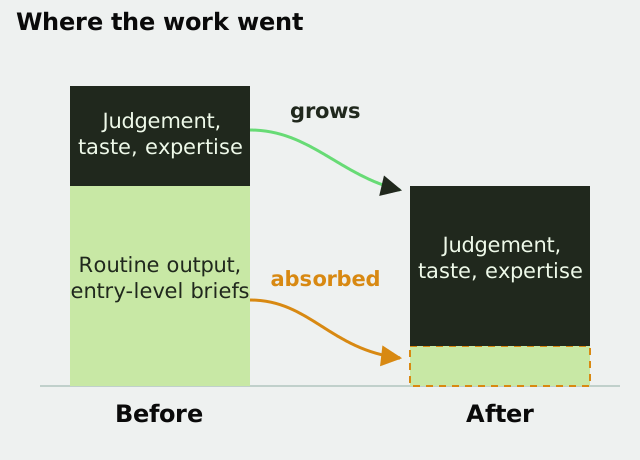
Gone: clean single-speaker audio at general rates. Podcasts, dictation, clear interviews. Software handles these well enough that paying a person is hard to justify, and rates have fallen accordingly.
Grew: post-editing. Software produces a draft that is roughly right and confidently wrong in specific places, usually proper nouns, technical terms, homophone confusions and speaker attribution. Catching those is a real skill and the volume of it is large.
Unaffected: anything with consequences. Medical, legal and regulated content still requires somebody who can be held accountable, and "the software wrote it" is not an acceptable answer in those settings.
New: checking machine transcripts for errors, captioning short creator clips and cleaning interview recordings. These draw on the same listening skills but arrive as smaller proof-based jobs rather than long transcription contracts.
Getting started
The barrier is a test rather than a credential, for general work.
Learn the conventions
Speaker labels, timestamps, how to mark inaudible sections, whether filler words get cleaned up. Every client has a style guide, and most entry tests fail people on formatting rather than on hearing.
Practise on real audio
Find a recording with several speakers and background noise, transcribe fifteen minutes of it, and time yourself honestly. That number is your actual rate, and knowing it before you accept a deadline prevents the most common early mistake.
Take the entry tests seriously
Most platforms gate work behind one, and the result sets both your tier and your rate. Read the style guide fully first.
Start with post-editing
It reaches a usable hourly rate faster than raw transcription, and it teaches you where machine output typically fails.
Then specialise
Whatever background you have — clinical, legal, technical, or a second language — routes you to a band paying several times general rates.
That last step is the whole difference between transcription paying badly and paying well.
Equipment
Almost nothing, and nothing before your first paid job.
What you need is decent over-ear headphones and free transcription software with keyboard shortcuts for play, pause and rewind. That combination covers the entire job.
Helpful at volume: a foot pedal, around $50, which frees both hands and meaningfully increases speed once you are working regularly. Buy it in month two rather than week one.
Getting faster, which is the whole rate
Because transcription is paid per audio hour, your speed is your rate.
Doubling your speed doubles your income with no negotiation, and most of the gain comes from technique rather than practice hours.
Learn the shortcuts properly. Play, pause and a five-second rewind on keys your fingers reach without leaving the home row. The single largest speed factor for beginners is reaching for a mouse.
Type continuously and correct in a second pass. Stopping to fix each error breaks the rhythm and costs more than the errors do. Transcribe roughly, then clean.
Slow the playback rather than rewinding. Most players do 0.75x without pitch distortion. One pass at 0.75 beats three passes at full speed on difficult audio.
Build a shortcut list for repeated terms. Text expansion for names, technical vocabulary and phrases that recur throughout a recording. On a long specialist file this is significant.
Learn the client's style guide once, properly. Reformatting after the fact is slower than getting it right, and formatting errors are the most common reason a submission is returned.
Listen ahead. Experienced transcriptionists are typing one phrase behind what they are hearing rather than stopping at each one. This feels impossible and arrives suddenly, usually around the twentieth hour.
Turn down the audio you cannot win. A recording with three people talking over each other in a restaurant may take six hours per audio hour. Declining it is a rate decision, not a failure.
What to watch for
Rates quoted per audio hour without saying so. Always divide by your real speed.
Unpaid test transcriptions of real length. A five-minute sample is reasonable. Forty-five minutes of client audio described as an assessment is unpaid work.
Impossible deadlines on difficult audio. A four-hour turnaround on ninety minutes of six-speaker conference audio is not achievable at quality, and accepting it means either a poor submission or an all-nighter.
Platforms charging for access or certification. Same rule as everywhere.
Quality scores with no appeal. Some platforms downgrade your tier based on reviews you cannot see or contest. Worth knowing before you build a reliance on one, and worth comparing against a platform where a rejection opens a decided appeal.
Where the work is posted
Four routes, and they differ more than the rates suggest.
Transcription platforms. The standard entry point. You pass a test, get assigned a tier, and claim files from a queue. Steady availability, lower rates, and the queue is competitive at the good end — the well-paid files disappear within minutes of posting.
Transcription agencies. Smaller outfits serving specific sectors, often legal or medical. Higher rates, application rather than instant signup, and once you are on a roster the work is regular.
Direct clients. Researchers, podcasters, law firms, production companies. Best rates by a distance, because there is no platform margin, and you handle the invoicing and the chasing. Academic departments are a consistently underused source — most run interview studies and most have no arrangement in place.
Task marketplaces. Where shorter audio jobs and mixed transcription-plus-tagging work appear alongside other tasks on a general marketplace carrying mixed small jobs. Suits people who want it occasionally rather than as a queue to sit in.
A workable pattern is a platform for baseline volume while approaching agencies and direct clients for the better-paid work. Relying on one queue means accepting whatever it pays this quarter.
Confidentiality, which is not boilerplate
More of this work is sensitive than people expect. Research interviews contain identifiable participants. Legal audio contains privileged material. Medical files contain patient data. Business recordings contain unannounced decisions.
Three habits, all straightforward. Do not store client audio longer than the job requires, and delete it when the invoice clears. Do not transcribe sensitive material in a shared or public space where a screen or audio can leak. And treat what you hear as confidential permanently — obligations under these agreements do not end when the job does.
This matters practically as well as ethically. Sectors paying the best rates are the ones with the strictest requirements, and a transcriptionist with a clean record on handling sensitive material is exactly who they rebook.
Whether it is worth it
Without a specialism
One of the weaker options once real hours are counted. $5 to $15 an hour for concentrated work is below most alternatives in this category, and the trend is not improving.
With one
For anyone with a clinical, legal or technical background, or a second language, this is among the better-paid remote work available, and the demand is genuine and unmet.
The honest test is whether you have something that makes you faster or more accurate than a generalist. If yes, this pays well. If no, the same hours spent elsewhere return more, and the comparison of what each option pays sets out where.