Remote side work is sold as borderless and mostly is not. The task is borderless — a file is a file — but eligibility, payment routing and fees all care very much where you are.
None of that makes the work unavailable. It changes which work is worth pursuing, and it changes what a listed rate actually means once the money lands.
What travels and what does not
| Type of work | Accepts any country | Restricted by geography |
|---|---|---|
| Freelance services | Yes | Rarely |
| UGC and content production | Mostly | Sometimes, for market fit |
| Transcription and captioning | Yes | No |
| Translation | Yes | Language, not location |
| Task and campaign work | Mostly | Per campaign |
| Website and app testing | Partly | Often |
| User research interviews | No | Usually one market |
| Survey panels | No | Nearly always |
The pattern is straightforward once you see it. Work where the buyer wants a deliverable travels anywhere. Work where the buyer wants a person from a particular market does not, because the market is the thing being purchased.
Why restriction is sometimes good for you
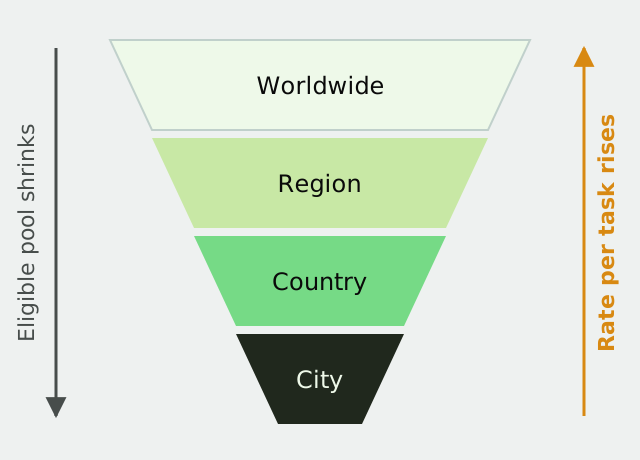
Geographic limits look like a barrier and function as a filter, and filters cut competition.
An open global task competes with everyone. A campaign restricted to Dutch speakers in the Netherlands competes within a pool of a few hundred people. The rate on the second is usually higher and the odds are dramatically better.
This is the single most underused advantage available to anyone outside the largest English-speaking markets.
If you can work in a language other than English, that is not a limitation to work around. It is the scarce input, and it should be the first thing on your profile.
Two things follow practically. Fill in country and languages properly, because eligibility matching runs on those fields and an incomplete profile silently removes you from the briefs you would win. And when you find a restricted brief you qualify for, prioritise it over an open one paying the same, because you will actually get it.
The remote options worth starting with
Freelance services
The mechanics of that narrowing are set out in how campaign country targeting works.
Travels best of anything on this list, pays best, and needs no permission from a platform. Writing, design, video editing, bookkeeping, development, spreadsheets, administration, translation. If somebody pays for it in an office, somebody pays for it remotely.
The rate starts around $25 an hour and the constraint is finding clients rather than doing work. That is uncomfortable and it is exactly why the rate holds.
Content and UGC production
Filming short videos brands post on their own channels. Global by default, with occasional briefs restricted where the setting or accent is part of the purchase.
Rates run well above general task work, and pricing depends far more on the usage licence than on where you live. The ramp is four to eight weeks while you build something to show, most of it spent on the portfolio rather than on filming.
Task and campaign work
Small verifiable jobs with payment attached. Mostly open globally, with per-campaign restrictions.
Fastest route to a first payment anywhere in the world, because there is no interview, no portfolio and no client relationship to build. It does not compound, so treat it as the thing paying this week rather than the plan.
Transcription and translation
Unrestricted by geography and priced on skill. Transcription pays modestly, around $12 to $25 an hour once you are quick. Translation pays considerably better and the rate scales with how uncommon the pair is.
If you are bilingual, translation is almost always the highest-value remote work available to you, and it is chronically underserved outside the major pairs. Transcription in a single language is the lower rung of the same skill and takes a test rather than a portfolio.
What actually arrives: the fee arithmetic
This is the part listings never mention and it changes the decision.
A $40 payment can arrive as $32. The gap comes from three places:
Currency conversion. Platforms and payment providers frequently convert at a rate two to four percent worse than the mid-market rate, and they rarely show the comparison. Look up the mid-market rate and compare it to what you were credited.
Transfer fees. Either a flat fee, which hurts small payments disproportionately, or a percentage. A $3 flat fee on a $40 withdrawal is seven and a half percent.
Four checks before committing to any platform:
- What currency am I credited in, and what currency do I withdraw in?
- What is the conversion rate against mid-market on the day?
- What is the withdrawal fee, flat or percentage?
- What is the minimum, and how many hours of work is that at the listed rate?
Run those once per platform and the honest hourly rate becomes visible. It is frequently ten to twenty percent below the advertised one.
Batching withdrawals helps where the fee is flat. Withdrawing $200 once costs a quarter of what withdrawing $50 four times does. How payouts work here states the currency, the threshold and the timing in one place, which is the format worth demanding from any platform.
Getting eligible for more of the restricted work
Since restricted briefs are the better-paid ones, it is worth knowing what actually widens eligibility.
Complete every profile field. Country, city, languages, and whatever the platform uses for verification. Matching runs on structured fields, not on the free-text description, and an empty field is treated as a disqualification rather than a maybe.
Verify location where the platform offers it. Verified workers see briefs unverified ones never do, because buyers paying for a market-specific result want assurance the result comes from that market. On Brief Buck, campaigns can target worldwide, a region, named countries or named cities, with language requirements applied on top, and eligibility is checked before a worker can reserve a spot rather than after they deliver.
List every language you can genuinely work in, at the right level. Overstating this is the fastest way to a rejection you cannot appeal. Understating it costs you the best-paid briefs available to you.
Say which markets you know, not just where you live. Someone who lived in Spain for six years and now lives elsewhere is a legitimate fit for some Spanish-market work. Where a platform allows a free-text note, that belongs in it.
Do not discount for where you live
The most expensive habit among remote workers outside high-wage markets is pricing against local wages.
A brand in London or New York is budgeting against what creative work costs in London or New York. They are not comparing you to people in your city, and most of the time they do not know or care where you are. Quoting half the market rate because it is generous locally leaves money on the table for a buyer who would have paid the full amount without comment.
The exception is genuine competition on identical commodity work, where the lowest bidder wins and the rate is set globally at the bottom. The answer there is not to price lower. It is to stop competing on commodity work, which means specialising until the comparison is no longer like-for-like.
Time zones, which mostly help
The assumption is that distance from the client is a disadvantage. For asynchronous work it is usually the opposite.
Where distance helps
A brief sent at 5pm in New York and delivered by 9am the next morning looks like exceptional turnaround. It cost you an ordinary working day. Clients notice speed far more than they notice where it came from.
Where overlap genuinely matters
Live research interviews, real-time collaboration, and anything with same-day back-and-forth. If those are your main work, either accept some unsociable hours or concentrate on markets within a few hours of you.
State your working hours in your own time zone and note the overlap with theirs. It removes an objection before anyone raises it.
Reading a platform's country policy before you invest
Platforms differ enormously in how they treat workers outside their home market, and the difference is rarely on the marketing page.
Four things to establish before building a profile:
Which countries can register at all
Some platforms restrict signup outright, usually for payment-provider or sanctions reasons. Better to find this out before writing a profile than after.
Whether eligibility is per-task or account-wide
Per-task restriction is normal and fine — you see fewer briefs but you are a full member. Account-wide tiering, where workers from certain countries are permanently limited to lower-paid work regardless of performance, is a different proposition and worth knowing about.
Whether identity verification is possible from where you are
Some verification providers do not support all countries, and hitting that wall with an unwithdrawable balance is a common and miserable outcome.
What happens if you travel
Platforms that check location can flag an account that suddenly appears elsewhere. If you move around, find out whether that is a problem before it becomes one.
None of these questions are hostile and support teams generally answer them. Asking takes ten minutes and occasionally saves a month.
Building repeat clients across borders
One-off remote work is easy to find and exhausting to sustain, because every payment requires a fresh search. Repeat clients are the entire difference between a remote side hustle that stays small and one that becomes reliable income.
The mechanics are unglamorous.
Deliver slightly early, consistently. Across a time zone this is nearly free, and it is the single thing clients remember.
Overcommunicate at the start, then go quiet. Confirm the requirements in writing before beginning. Then deliver without a running commentary. Clients working remotely fear silence followed by the wrong thing, and confirming up front removes that fear permanently.
Ask what happens next. At delivery, one sentence: "Happy to take the next batch whenever it's ready." Most freelancers never ask, and asking converts a surprising share of one-off work into ongoing work.
Keep your own record of who booked you. Platforms change, accounts get restricted, and a client list you control is the only durable asset in this. Names, what they bought, what you charged, when.
Move the relationship off the platform only if the terms allow it. Many prohibit it and enforce it. Breaking that rule to save a fee is a bad trade against losing an account with a balance in it.
Most of this work is contracted rather than employed, and what that classification actually costs is worth reading before scaling up.
Practical admin
Tax is owed where you live, generally from the first payment, regardless of where the client is. Some countries also have rules about foreign income specifically. Keep records in both the currency you were paid in and your own.
Payment identity must match. Platforms increasingly verify that the withdrawal account belongs to the account holder. Mismatches freeze balances, and unfreezing them is slow.
Invoice even when you do not have to. A numbered invoice per payment makes a year of records trivial to reconcile, and some clients need one to pay you at all.
Keep a separate account for this income if you can. It costs nothing and turns the annual accounting into a short job.
Where to start this week
Pick one thing that travels — freelance services if you have a professional skill, content work if you have a phone and patience, task work if you need money in days.
Complete one profile fully, with country and languages filled in properly, because that is what decides which briefs you ever see. Then run one small job all the way through to a withdrawal so you learn the real fee arithmetic while your balance is too small for it to matter.
After that it is volume and specialisation, in that order. The comparison of what each home side hustle pays covers which of them have a rate curve worth climbing.