Mystery shopping is bought in two quite different ways, and buyers frequently purchase the expensive one when they needed the cheap one, or the reverse.
The two ways it is bought
A full-service agency
Designs the programme, recruits and manages shoppers, standardises the questionnaire, collects the reports and delivers analysis with benchmarks. You receive interpretation.
A task platform
Distributes your brief to eligible people near the locations, collects structured proof, and hands you the observations. You receive data.
The distinguishing question is whether you know what you want to measure. If you do, the interpretation layer is a markup on something you can do yourself. If you do not, it is the entire value.
What each costs
| Full-service agency | Task platform | |
|---|---|---|
| Per completed visit | $40 – $150 | Reward you set, plus fee |
| Programme design | Included | Yours to write |
| Shopper recruitment | Included | Platform pool |
| Questionnaire standardisation | Included | Yours to write |
| Analysis and benchmarks | Included | None |
| Setup time | Weeks | Days |
| Minimum commitment | Often annual | Per campaign |
The agency figure is not a markup for its own sake. A meaningful share of it is programme design, shopper vetting, and the analytics that make a hundred visits comparable — genuine work, correctly priced when you need it.
It is poor value when what you actually wanted was fifty photographs of a shelf.
When the agency is right
You do not yet know what to measure. Designing a questionnaire that produces actionable data is a specialist skill, and a badly designed one produces a hundred useless reports at any price.
For what the assignments look like to the people completing them, mystery shopping from the shopper's side covers fees, reimbursement and reliability, and what the method is for covers where it came from.
You need sector benchmarks. Knowing your greeting time is ninety seconds is less useful than knowing the sector average is forty. Agencies hold that comparison data and platforms do not.
Compliance or safety observation. Anything where the finding might be contested, or where evidentiary standards matter, wants a managed chain of custody and a supplier who will stand behind the methodology.
Very large multi-site programmes. Several hundred locations on a recurring schedule is an operations problem, and paying somebody to own it is usually correct.
When a task platform is enough
You know exactly what to check. Is the promotional display up, is the product in stock, what is the shelf price, how long is the queue, is the drive-through screen working.
You need coverage in specific places quickly. Twelve cities this week, targeted by city, with photographic proof from each.
The question is factual rather than experiential. Observations that produce numbers and images rather than judgements about service quality.
You want to test the idea before committing. Running fifty observations on a platform costs a fraction of an agency pilot and tells you whether the data would change any decision. A surprising number of programmes fail that test, and finding out cheaply is worth something.
Budget is the binding constraint. Twelve sites checked monthly is affordable on a platform and frequently is not through an agency.
On Brief Buck you write one brief, set the reward per person and the number of spots, target by country, city or language, and specify the proof — photographs, a written note, timings, or a combination. Funding is committed before the brief publishes, eligibility is checked before somebody reserves, and review runs on a fixed clock with one correction request and a 72-hour appeal on any rejection.
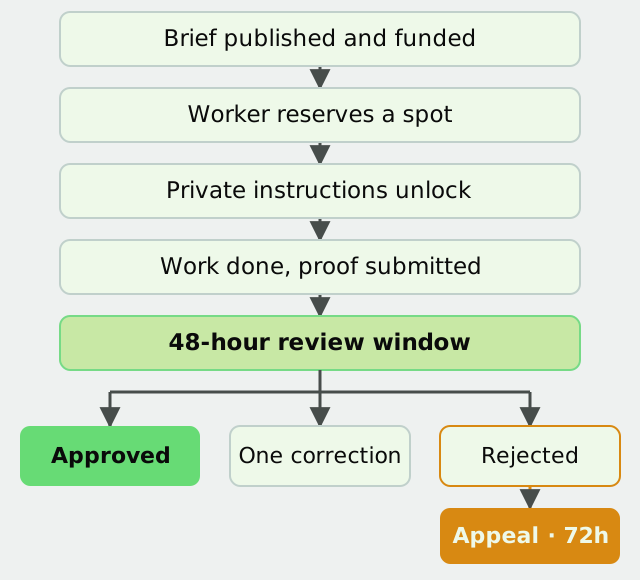
There is no analysis layer, and pretending otherwise would waste your time. The task marketplace page sets out the same mechanics for work that is not retail observation.
Designing it so the data is usable
Whichever route you take, these decide whether the programme produces anything.
Ask for measurements, not impressions
"Was the service good?" returns adjectives that cannot be aggregated. "How many seconds until you were greeted?" returns a distribution you can compare across sites and across months.
Number the questions and require all of them
Partially completed observations are the main source of unusable data at volume.
Cover the edge cases
What should somebody record if the location is closed, the product is absent, the promotion has ended? Without an instruction each person improvises.
Require evidence alongside the answer
A photograph next to a stated price makes the record checkable and changes how carefully people answer.
Visit often enough to see a pattern
One visit per site measures one shift. Two to four per quarter is a reasonable floor for distinguishing a systemic problem from a bad Tuesday.
Rotate people
Any programme where the same shopper visits the same site repeatedly is measuring how staff treat that individual.
Shopper quality, and what actually drives it
Buyers assume shopper quality is a recruitment problem. It is mostly a brief problem and a terms problem.
A clear brief produces consistent observers. Ambiguous questions produce variation between people that looks like unreliable shoppers and is actually unreliable instructions. If two careful people would answer differently, the question is wrong.
Fair terms keep a pool available. Where work can be rejected without explanation, experienced observers stop taking that client's assignments and you are left with first-timers indefinitely. This is invisible on any single campaign and decisive across a year.
Reliability compounds. People who file clean reports on time should be invited back to the same programme, because the second visit from a known observer costs less to review and is more comparable to the first.
On Brief Buck the terms are fixed: funding committed before publishing, one correction request rather than unlimited revisions, automatic approval if a reviewer goes quiet, and a 72-hour appeal decided by an administrator rather than the poster. Those are worker-side terms and they exist because a pool that has been treated badly is a pool that does not answer your next brief.
Coverage, and where it gets difficult
Worth setting expectations before designing a programme around locations.
Dense urban areas fill quickly and cheaply. Plenty of eligible people, short travel.
Smaller towns fill more slowly and need a higher reward to cover travel. This is the most common cause of a programme returning partial coverage.
Remote sites may not fill at all at any reasonable rate, and no supplier can conjure a population that is not there. An agency will tell you this after taking the brief; it is cheaper to find out during a pilot.
International coverage varies enormously by market. Targeting by country and language handles the mechanics; whether the people exist in a given city is an empirical question worth testing with a small campaign first.
The failure nobody plans for
Most mystery shopping programmes that disappoint were not badly executed. They produced accurate reports that nobody acted on.
Before commissioning anything, answer one question: what decision will this data change?
If the honest answer is that it will be circulated and filed, the programme is an expense regardless of how well it runs.
Programmes that work have a named owner, a threshold that triggers action, and a route from a finding to somebody who can fix it. That structure costs nothing and it is the difference between measurement and theatre.
Questions to ask any supplier
Whether an agency or a platform, these separate serious suppliers from the rest.
- Who are the shoppers, and how is it verified they were actually there?
- What happens when a report is disputed by a site manager?
- How quickly does an observation reach me after the visit?
- Can I see the raw responses, or only your summary?
- What does it cost to add a location, and to add a question?
- Is there a minimum term, and what happens if I stop?
The third and fourth matter more than they look. Data arriving three weeks after the visit is history rather than an operational signal, and a supplier who will only show you the summary is selling you their interpretation of something you paid to collect.
Frequency, and reading the results
Two design decisions determine whether a programme produces signal or noise, and both are usually set by budget rather than by statistics.
How often. One visit per site per quarter measures one shift, four times a year. A site with a genuine staffing problem and a site having a bad Tuesday look identical. Two to four visits per site per quarter is the floor at which a pattern separates from an incident, and it is worth cutting the number of sites rather than the number of visits if budget forces a choice.
When. Visits clustered at the same time of day and the same day of week measure that slot rather than the site. Spread them across the trading week, including the shifts nobody wants to be measured on.
Reading the output, three habits help. Compare a site against itself over time before comparing it against other sites, because location differences swamp most effects. Look at the distribution rather than the average, since one site with wildly variable service is a different problem from one that is consistently mediocre. And treat a single dramatic report as a prompt to look rather than as a finding.
A sensible first step
Pick five locations and one question you genuinely do not know the answer to. Run twenty observations against it. Read the raw responses yourself before anyone summarises them.
That costs very little either way and settles two things at once: whether the observations tell you something you would act on, and whether you need somebody to interpret them. Both answers are cheaper to buy at twenty visits than at two hundred.
The same verification problem turns up wherever people are deployed to places nobody from head office will visit, and how experiential campaigns are staffed and checked covers the version of it that runs through a subcontracting chain.