The honest answer to this question disappoints people, so most articles about it avoid giving one.
You cannot get paid cash for writing Amazon reviews through any route that is both legitimate and safe. Amazon prohibits it. Consumer-protection regulators prohibit undisclosed paid endorsements. The offers you find promising $10 or $20 a review exist outside both, and the risk sits with you rather than with the person paying.
What does exist is a legitimate programme that pays in products, and a set of adjacent work that pays properly in money for opinions about products. This covers both, and it covers what happens when the shortcut goes wrong.
Why paid reviews are prohibited
Two separate rule sets apply, and people usually only know about one.
Amazon's own policy
Community guidelines forbid creating, editing or posting content in exchange for compensation of any kind, including free or discounted products, refunds and reimbursements. The single carve-out is Amazon Vine, which is Amazon's own programme and is labelled as such on every review it produces.
Consumer-protection law
Separately from anything Amazon wants, regulators treat an undisclosed paid endorsement as a deceptive practice. In the United States the Federal Trade Commission has a rule addressing fake reviews and testimonials, with civil penalties attached. The UK and EU have comparable regimes.
Enforcement has been aimed mainly at the businesses buying reviews and the brokers arranging them, though writers are not categorically outside it. The reasoning behind both rule sets is the same: a review's only value is that it reflects a genuine experience.
Pay for it and you have not bought a review, you have bought an advertisement wearing one as a costume.
What Amazon Vine actually is
Vine is the legitimate version, and it is worth understanding precisely because it is so often misdescribed.
Sellers enrol products into the programme and Amazon distributes them to selected reviewers. Those reviewers receive the product free, keep it, and write an honest review. Every review produced this way carries a label identifying it as a Vine review of a free product, so readers can weigh it accordingly.
Three things people get wrong about it:
You cannot apply. There is no signup form. Amazon invites reviewers based on how helpful their existing reviews have been to other customers. Any site charging a fee to get you into Vine is selling something that does not exist.
It pays in products, not cash. You receive things, not money, which puts it alongside the wider category of free product testing rather than paid work.
Honest means honest. Vine reviewers are expected to write critical reviews where a product deserves one, and consistently positive reviewing is not the way to stay in the programme. The programme's value to Amazon depends on the reviews being real.
If you want into Vine, the only route is writing genuinely useful reviews of products you actually bought, over time, and being noticed. That is slow and there is no shortcut, which is exactly why the shortcut market exists.
How the paid-review offers work
They arrive by direct message, in Facebook groups, on Telegram, or through a site advertising "product testing". The structure is nearly always one of these:
Buy and refund. You purchase the product yourself at full price, post a five-star review, then send proof and receive a refund plus a small fee by transfer or gift card. Your money is out for days or weeks, and there is nothing compelling the refund. Non-payment is common and there is no route to complain, because the arrangement was against the rules to begin with.
Free product for a guaranteed rating. The rating is agreed in advance, which is precisely what makes it a fake review rather than a review. This is the version most likely to get an account closed.
Review-swap groups. Members review each other's products or listings. Amazon detects these reliably through purchase and account patterns, and enforcement tends to hit everyone in the group at once.
Paid brokers. An intermediary places reviewers with sellers. The seller carries the largest legal exposure, and the reviewer carries the account risk with no contract and no recourse.
What all four share: your side of the deal is enforceable by nobody, and the thing you are risking is worth far more than the fee.
What it costs when it goes wrong
Worth spelling out because the fee on offer is usually $10 to $30.
Set that against $15 and the arithmetic is not close.
What pays real money for product opinions
Here is the part the question is usually reaching for. Companies genuinely will pay you for a considered opinion about a product. They just will not pay you to publish it on a retail listing.
Product testing panels. You receive a product, use it properly, and complete a structured feedback report for the manufacturer. Payment is cash or the product, feedback goes to the company rather than a public listing, and nothing is published under your name.
User research sessions. Watching or using something while a researcher asks questions, the way usability testing is run. This is the highest-rate work in the category.
Paid video feedback. A brand needs a reaction to an advert, a package design, or a competitor's campaign. How that work is structured covers what buyers are actually looking for.
Creator content commissioned by brands. You film an honest short video about a product and the brand posts it on their own channels as their own advertising. Disclosed by design, because the brand is openly advertising, and rates run to several hundred per clip.
Structured task work. Checking whether a listing renders correctly in your country, verifying a delivery experience, comparing prices across regional storefronts. Small, specific, verifiable, and entirely legitimate because nothing is being passed off as an organic customer opinion.
The line running through all of these is simple. You are paid for the work of forming and reporting an opinion. You are not paid to pretend an opinion was unprompted.
The seller side of the same question
A large share of people searching this are not reviewers. They are sellers wondering how to get reviews on a listing that has none, and the honest answer for them is worth stating because it is the demand keeping the fraud market alive.
Buying reviews exposes a seller to more than it exposes a reviewer. Listing suppression, account suspension, withheld disbursements, and regulatory penalties where the activity is systematic. Amazon's detection has improved considerably, and enforcement tends to arrive after the money has been spent rather than before.
The permitted routes are slower and they work.
Enrol in Vine. Sellers pay a fee per enrolled product and Amazon distributes it to its own reviewers. Reviews are labelled, honest, and sometimes critical, which is the trade.
Use Amazon's own request-a-review function. Buyers who actually bought can be asked once, through Amazon's tooling, with no incentive attached. Unglamorous and entirely permitted.
Fix the product and the listing first. A steady trickle of unprompted negative reviews is information rather than a marketing problem, and buying positive ones on top of it just raises the volume of disappointed buyers.
Commission content instead of reviews. Paying creators for video and photography you post as your own advertising is legitimate, disclosed by construction, and usually more useful for conversion than another five-star line. That is a different purchase from a review, and it is the one that survives scrutiny.
Telling a real testing programme from a review scheme
The offers overlap in how they present themselves, so check these four things:
Where does the output go?
To the company, or to a public listing? Feedback delivered privately to a manufacturer is legitimate research. A required public review with a specified rating is not.
Is the rating specified in advance?
Any mention of five stars, positive sentiment, or a minimum rating means the product being purchased is the rating.
Do you pay first?
Buy-and-refund is the defining structure of the review-fraud market. Legitimate testing sends you the product or pays you directly.
Is the compensation disclosed to readers?
Vine labels its reviews. Brand-commissioned content is posted by the brand as advertising. Anything relying on the audience not knowing money changed hands is the thing regulators are aimed at.
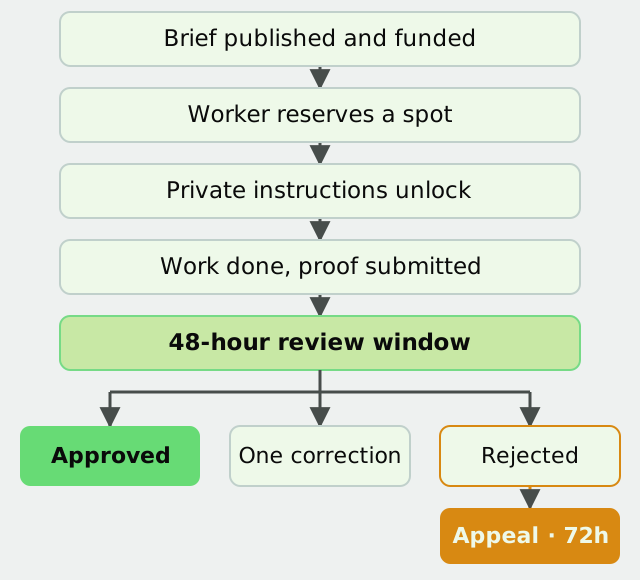
Where the work is task-shaped, two more things are worth checking on any platform: whether the money is committed before you start, and whether a rejection can be challenged. On Brief Buck campaigns are funded before they publish, the reward and required proof are visible before a worker reserves a spot, and a rejection opens a an appeal decided by someone other than the buyer decided by an administrator rather than the poster who rejected it. Campaigns requiring reviews from people who have not used the product are refused at moderation, which is the same line this article is drawing.
Disclosure, and why it is the whole point
The rule underneath all of this is simpler than the policy documents make it look: the reader has to be able to tell that money changed hands.
That is why Vine reviews carry a label. It is why a brand posting a creator's video on its own account is fine — the account is the brand's, so the reader already knows it is advertising. It is why an influencer must mark a sponsored post. And it is why a paid five-star review from an apparently ordinary customer is the one arrangement that is prohibited everywhere, because it is the only one built on the reader not knowing.
Once you hold that principle, the whole category sorts itself without needing to memorise anyone's terms of service. Ask who the reader thinks is speaking, and whether that is true. If the answer is that a stranger is being led to believe an unpaid customer wrote it, no amount of wording fixes the arrangement.
It also explains why the legitimate work pays better. Disclosed work can be bought by real companies with legal departments and recurring budgets. Undisclosed work can only be bought quietly, in small amounts, by people who cannot be complained to.
If you actually want to review things
Some people asking this question do not primarily want money. They want free products and enjoy writing reviews.
That route exists and it is slower than the shortcut. Buy things you were going to buy anyway and review them properly: specific, balanced, useful to somebody deciding. Note what disappointed you. Include the detail the product page leaves out. Reviews that get marked helpful are what Vine selection notices, and helpfulness comes from being genuinely informative rather than enthusiastic.
Manufacturer testing panels are the other route, and most large consumer-goods companies run one. They are unglamorous, they involve forms, and they are real.
Neither pays cash quickly. If cash quickly is the requirement, the comparison of what home side hustles actually pay per hour is a more useful place to start, because paid reviews would have been a poor answer to that question even if they were allowed.