Somebody built an app that pays you to scroll, and a thousand articles were written about it without anyone checking the rate. The rate is a few cents an hour. The streaming variant works the same way and is covered in get paid to watch Netflix.
There is a real version of this. Brands pay actual money for a person to watch short-form content and report something useful about it, and that work is unglamorous enough that it never appears in the listicles. This covers both, with the arithmetic.
The passive version, and its ceiling
Reward apps credit you for time spent in-app or for watching sponsored clips. Points accumulate, points convert to cash or gift cards, and the conversion is usually somewhere you have to go looking for.
The ceiling is set by advertising economics rather than by anything you do. An advertiser pays roughly $5 to $30 for a thousand video impressions. The app keeps most of it. What reaches you is a fraction of a cent per view, and each view takes fifteen to thirty seconds.
No amount of diligence changes that. An hour of continuous scrolling generates a few dollars of advertiser spend in total, and you receive a slice of a slice.
Three mechanics push the effective rate lower still.
The same arithmetic governs the wider category of paid-to-watch apps, which is worth reading before signing up to any of them.
When it is still worth having
What TikTok itself pays for
Worth separating, because people conflate the two.
What TikTok pays for
Its own monetisation pays creators for content they post: creator fund arrangements, subscriptions, gifts on live streams, and the affiliate and shop programmes. All of it is payment for producing or selling.
What it never pays for
Viewing. No app pays you on TikTok's behalf for watching, and anything implying otherwise is a third party using the platform's name for recognition.
The version that pays properly
Companies need people to watch short-form content and tell them something specific about it. That demand is real, it is poorly served, and it pays in a different order of magnitude.
Ad and creative testing. A brand has four versions of a TikTok advert and needs to know which holds attention and where viewers drop. You watch, timestamp where you disengaged, and report what you remembered afterwards. Fifteen to twenty minutes, $10 to $40.
Trend research. A brand wants to know what is actually circulating in a niche this month — which sounds, which formats, which references. You scroll with purpose and produce a structured summary. This is the closest legitimate thing to being paid to scroll, and it pays $20 to $60 an hour because the output is a research document rather than a session log.
Localised content review. A campaign is launching in your market and somebody needs to know what will not land: a joke that fails, a reference nobody recognises, a claim that breaks local advertising rules. Geographically restricted, which cuts the competition sharply and raises the rate.
Comment and sentiment analysis. Reading responses under a brand's posts and categorising what people are actually complaining about. Tedious, genuinely valuable, and steadily paid.
Filming content yourself. The highest-paying option in the category. Brands pay $75 to several hundred for a short clip they post on their own channels, and no audience is required because they are buying the file. What that work pays and how usage rights change it is a subject of its own.
The common factor: you produce something. A timestamp, a summary, a rating, a file.
That output is the whole difference between 30 cents an hour and $30.
What makes someone good at the paid version
The skill is not watching. Everyone can watch. It is noticing, and being able to say what you noticed in a form somebody can act on.
Timestamp the drop-off. "Lost me at 0:07 when the music changed" is worth more than any amount of general impression. Buyers are hunting for the exact moment attention breaks.
Report recall, not opinion. Watch, wait sixty seconds, then write what you remember without rewinding. What survives that gap is what an advertiser actually bought.
Be specific about confusion. If you did not understand what the product was, say so and say when. Most people soften this into uselessness, and it is the single most valuable note on an early cut.
Do not perform. Exaggerated reactions are obvious and worthless. The buyer is trying to predict an ordinary viewer, and an ordinary viewer does not gasp.
Deliver exactly what was asked. If the brief lists three requirements, meet all three before adding anything of your own.
Do this consistently and buyers start requesting you directly, which is where the rate stops being the platform's listed rate.
Spotting the difference before you sign up
Five checks, each under a minute.
Is the rate quoted in money?
Points, coins, gems and credits all mean the conversion is somewhere you have not looked yet. If you cannot find it, that is your answer.
What is the withdrawal minimum, in hours?
Divide the threshold by the hourly rate. More than a few hours and the threshold is the business model.
Does earning depend on recruiting people?
Then the recruitment is the product, whatever else is being described.
Are you asked to pay anything?
For access, for a premium tier, for a starter pack. Legitimate work does not charge the worker.
Is the money committed before you work?
And can a rejection be challenged? The second is the one nobody checks.
Work that can be refused with no explanation and no appeal puts the whole risk of somebody's mood onto you. On Brief Buck the reward, eligible countries and required proof are visible before a worker reserves a spot, campaigns are funded before they publish, and a rejection opens a how a refused submission gets reviewed again decided by an administrator rather than by the poster who rejected it. The same five checks are worked through in more detail in the question of whether microtask sites are legit.
Why geography decides how much you see
Eligibility surprises people the first time a brief they wanted turns out to be restricted, and understanding it changes how you set up.
A great many content-feedback briefs are limited to specific countries. Usually that is because the brand is testing how something lands in one market, and a reaction from outside that market answers a question nobody asked. Sometimes it is because the product only ships there.
That cuts what you can access. It also means the briefs you do qualify for are competing within a much smaller pool. An open global task competes with everybody; a brief restricted to Polish speakers in Poland competes within a few hundred people, and it pays better for exactly that reason.
Two practical consequences. Fill in country and language fields properly, because matching runs on those and a blank field reads as a disqualification. And if you work in a language other than English, put it front and centre — non-English feedback work is chronically short of people and priced accordingly.
Turning irregular briefs into steady work
Content feedback arrives when campaigns need testing, not on a schedule. A month with nine sessions can be followed by one with two, and that unevenness is what makes people give up on it.
Three things smooth it.
Treat adjacent task types as one pool. The same profile usually qualifies you for ad testing, user research, written feedback, screenshot verification and localised review. Watching all of them roughly triples what you see without any new setup.
Get requested by name. Buyers running repeat campaigns keep a short list of people whose notes were actually useful, and re-inviting someone costs them nothing. Three or four clean deliveries is usually enough to get on it, and direct invitations skip the queue entirely.
Keep your own record. Who booked you, what they wanted, what you were paid. Platforms change and accounts get restricted; a client list you control is the only part of this that is durably yours.
Realistic monthly numbers
Running several reward apps is itself unpaid work. The middle two bands depend heavily on how many briefs you are eligible for, and the top one assumes a four-to-eight-week ramp before the first booking.
Nobody earns a living scrolling. People do earn a useful supplementary income from being reliably observant about what they scroll past, which is a different activity with a different rate.
What the buyer is paying for
It helps to know why anyone commissions this, because it tells you what to put in the deliverable.
The person buying is usually a performance marketer, and they are measured on cost per acquisition. Creative is the largest lever they have on it. They are running several versions of an advert, most will fail, and they need to know which one to put money behind before they spend it rather than after.
That is why they want timestamps rather than opinions. A note saying "I liked it" cannot be acted on. A note saying "I stopped at 0:06, the text was too small to read on a phone" changes the next edit.
It is also why they ask for people from specific markets, and why they ask the same question of several people. They are not looking for a verdict from you. They are assembling a pattern from ten responses, and your job is to be an accurate data point rather than a critic.
Understanding that changes how you write the feedback, and creators who write like a data point rather than a reviewer are the ones who get asked back.
Starting this week
Skip the reward apps unless you specifically want background pocket change.
Register on two or three places carrying content feedback and short-form task work. Fill in country and languages properly, because those fields decide eligibility for the better-paid geographically restricted briefs, and an incomplete profile removes you from them silently.
Take one small task and follow it through to a withdrawal, even for a few pounds. Completing the payment loop once teaches you more about a platform than any review, and you learn it while the balance is too small to matter.
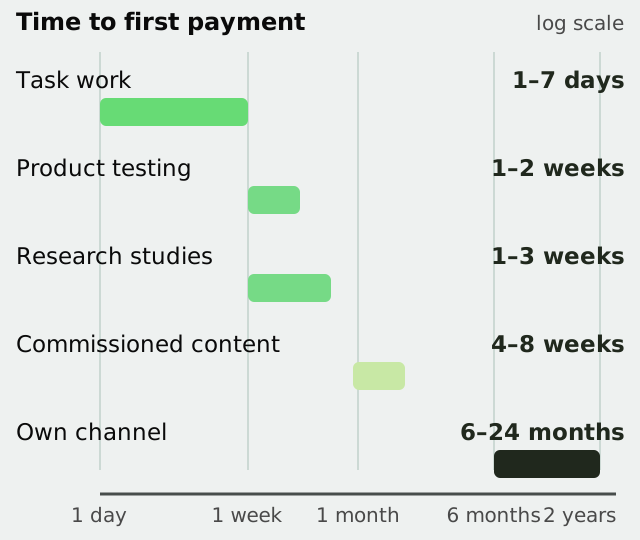
Then widen. The same profile that qualifies you for ad testing usually qualifies you for user research, written feedback and localised review, and treating them as one pool roughly triples what you see. If the content side appeals more than the feedback side, the seven-day route into paid creator work is the better ladder to climb.