Nobody at Netflix will pay you to watch Netflix. There is no programme, there has never been a programme, and the pages promising one are monetising the search rather than answering it.
What exists is a set of real jobs where watching is part of the work, plus a category of research and testing work that pays properly for attention. None of it resembles the fantasy in the headline, and some of it is genuinely worth doing.
The tagger job, accurately
This is the specific thing people have heard about, and it is usually described wrongly.
Netflix employs editorial and metadata analysts who watch titles and apply structured tags so the recommendation system can classify them. Tone, subject matter, themes, content warnings, the granular attributes behind those oddly specific category names on the homepage. The role is real and the work is real.
Three things make it a bad plan.
Openings are exceptionally rare. This is a small internal function at a company that does not need many of them. Positions appear on Netflix's own careers site occasionally and attract enormous numbers of applicants.
It is a job, not a side hustle. Employment, with an application, interviews, and usually a requirement to be in a particular location and available in working hours.
It is not casual viewing. You watch to a specification, apply a controlled vocabulary consistently across hundreds of titles, and get audited on consistency. People who do it describe it as detailed classification work that happens to involve video.
Streaming work that genuinely pays
Four categories, all real, none of them passive.
Content tagging and metadata. Streaming services, studios and the vendors who serve them need catalogues classified. You watch and apply structured attributes against a taxonomy. Accuracy and consistency matter far more than opinion. Usually project-based through media services vendors rather than the platforms directly.
Subtitle and caption quality checking. Reviewing machine-generated or outsourced captions against the audio: timing, spelling, speaker labels, whether the reading speed is achievable. Steady work if you have a language pair, and one of the few genuinely reliable streams in this area. Around $12 to $30 an hour depending on the languages and whether you are checking or creating.
Playback and app testing. Streaming services need their apps tested on real hardware in real homes, because a bug that only appears on a five-year-old smart TV on a slow connection cannot be found in a lab. You are paid to reproduce steps and report what happened. Pays well per session and appears irregularly.
Viewer research. A service wants to know how people actually browse, what makes them abandon a title in the first two minutes, whether a new interface confuses anyone. Moderated sessions with a researcher run $40 to $150 an hour. Unmoderated recorded sessions run $10 to $30 for fifteen minutes.
The pattern, again: every one of these pays for a deliverable. A tag set, a corrected caption file, a bug report, a recorded session.
Watching is the input, not the product.
What the "paid to watch" sites actually are
Search the phrase and most results fall into four groups.
Reward apps. Points for time spent, converting to a few cents an hour once you find the exchange rate and clear the withdrawal minimum. The arithmetic behind why that ceiling exists is set by advertising economics rather than by the app.
Affiliate content farms. Articles that exist to route you to survey sites for a referral commission. Recognisable because they list twenty "opportunities" with no rate attached to any of them.
Lead collectors. Sign up, hand over an email and phone number, receive nothing but marketing. The data is the product.
Paid lists. Sites charging a fee for a curated list of streaming jobs, which is a list of public job boards. No legitimate work charges the worker for access.
The tell across all four is the same: the pay is described enthusiastically and the work is not described at all. Real listings say what you would be doing, because they need someone able to do it.
Working out whether an offer is worth an evening
Five checks, each fast.
Is the rate in currency, not points? If earnings are in coins, credits or gems, find the conversion before doing anything. If you cannot find it easily, that is deliberate.
What is the withdrawal minimum in hours of work? Threshold divided by hourly rate. More than a few hours and the threshold is doing the real work for the business.
Are you asked to pay for anything? Access, training, a list, a premium tier. Never legitimate.
Is there a described deliverable? Real work produces something. If the entire task is "watch", the rate will match.
Can a rejection be challenged? The check almost nobody runs. If your submission can be refused with no explanation and no appeal, every hour carries a risk you cannot price. Look for a stated review window, automatic approval when a buyer goes silent, and a neutral party deciding disputes.
What it actually pays
Honest monthly figures for someone doing this alongside other things.
| Work | Rate | Realistic monthly |
|---|---|---|
| Reward apps | $0.10 – $1/hr | $2 – $15 |
| Unmoderated viewer research | $10 – $30/session | $40 – $200 |
| Moderated research interviews | $40 – $150/hr | $50 – $400 |
| Playback and device testing | $20 – $60/session | $40 – $250 |
| Caption checking and QC | $12 – $30/hr | $200 – $900 |
| Metadata and tagging projects | $15 – $25/hr | Project-dependent |
The two columns diverge because rate and volume are different problems.
High rate, thin volume
Moderated research pays superbly and arrives three times a quarter.
Moderate rate, steady volume
Caption work pays moderately and can fill as many hours as you want if you have a language pair.
Anyone chasing steady money in this area should look at the bottom two rows and ignore the top one.
What playback testing actually involves
Worth describing properly, because it is the category most people qualify for and least understand.
A streaming service runs on hundreds of device and software combinations: smart TVs going back years, set-top boxes, consoles, phones, browsers. A fault that only shows on one 2019 television model with a particular firmware version cannot be found in a lab that does not own that television. You do.
A session usually looks like this. You are sent a script of steps — open the app, search for a title, start playback, skip forward two minutes, background the app, return to it. You follow them exactly, record your screen or film the television, and report what happened at each step against what was supposed to happen.
The skill is precision rather than insight. Report exactly what you saw, in order, with the device and software version stated. "Playback froze" is a poor report. "Playback froze at 2:14 after resuming from background, audio continued, app recovered after 8 seconds, Samsung TU8000, firmware 1402" is a report somebody can act on.
Two things get people invited back. Owning unusual hardware, because coverage is exactly the problem being solved. And writing reports that need no follow-up questions.
List every device you own on any testing profile. Old hardware is an asset here, which is true almost nowhere else.
The language advantage
If you work in a second language, this is where it pays.
Subtitle creation, caption checking, localisation QC and metadata work in non-English catalogues are all chronically short of people. Streaming catalogues are global and the volume of localisation work is enormous, while the pool of people who can do it accurately in any given pair is small.
Rates for less common pairs run well above the general figures above. The work is also steadier, because localisation is a continuous pipeline rather than a project that finishes.
Two practical notes. State the pair and your direction of travel precisely, since translating into your native language is a different service from translating out of it. And expect a test — most vendors set one, and it is genuinely used to filter.
Why streaming companies buy this at all
Understanding the buyer makes you better at the work and better at spotting which offers are real.
A streaming service competes on two things: what is in the catalogue, and whether people can find something they want to watch before they give up. The second is a metadata problem. If a title is tagged badly, the recommendation system cannot surface it to the people who would have loved it, and an expensive acquisition earns nothing.
That is why tagging is done by people rather than software, and done to a controlled vocabulary rather than in free text. Two analysts describing the same film in their own words produce two useless records. Two analysts applying the same taxonomy produce a searchable catalogue.
The same logic runs through the rest of it. Caption errors drive viewers away in markets the service paid to enter. A playback bug on a common television costs subscriptions in a way that is invisible until somebody with that television reports it. Viewer research exists because the analytics show that people abandoned a title and cannot show why.
In every case the company is buying a specific, structured observation from a person it cannot get any other way. Work that fits that description is real. Work that asks for nothing but your time is not being bought by anyone, which is why it pays what it pays.
How to start without wasting a month
Skip the reward apps
Unless you specifically want background pocket change.
Register with two or three research and testing panels
Complete every profile field, especially country, languages and the devices you own. Device coverage is what gets you invited to playback testing, and people leave it blank.
If you have a language pair, approach localisation vendors directly
They advertise less than they recruit, and a direct enquiry with your pair and availability gets read. This is the highest-value move available to a bilingual person in this category.
Take one small task through to withdrawal
Even for a few pounds. Completing the payment loop once tells you more about a platform than any review, and you learn it while the balance is too small to matter.
Widen out
The same profile that qualifies you for viewer research usually qualifies you for app testing, short written feedback and localised content review. Treating them as one pool rather than four separate hunts roughly triples what you see.
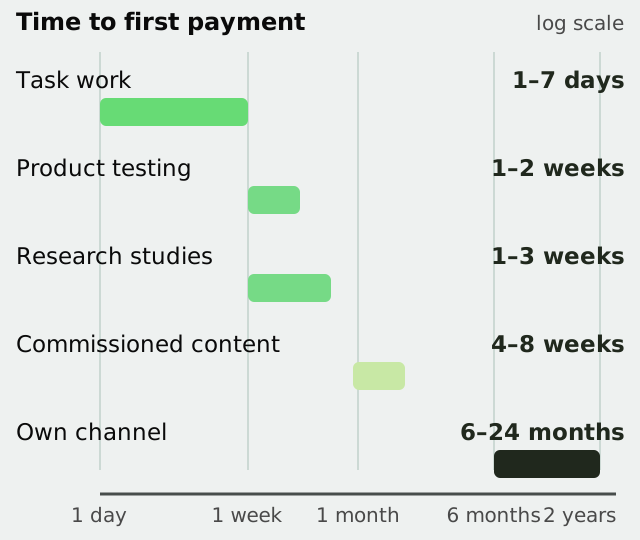
The routes differ mostly in how long each takes to produce a first payment.
None of this is being paid to watch Netflix. It is being paid to notice things accurately, on a schedule, with something to hand in at the end. That job exists and the other one does not.