Most articles about earning from a phone list the same reward apps and never state a rate. The rate is why they never state it. The most-searched version of this is getting paid to scroll TikTok, and the arithmetic there is worth seeing before starting.
A phone is genuinely valuable to people who will pay for it, but not as a passive earning device. It is valuable because it is a camera, a microphone, a screen recorder and a location sensor that happens to be carried by a real person in a real place. Those are the four things being bought.
Ranked by what it pays
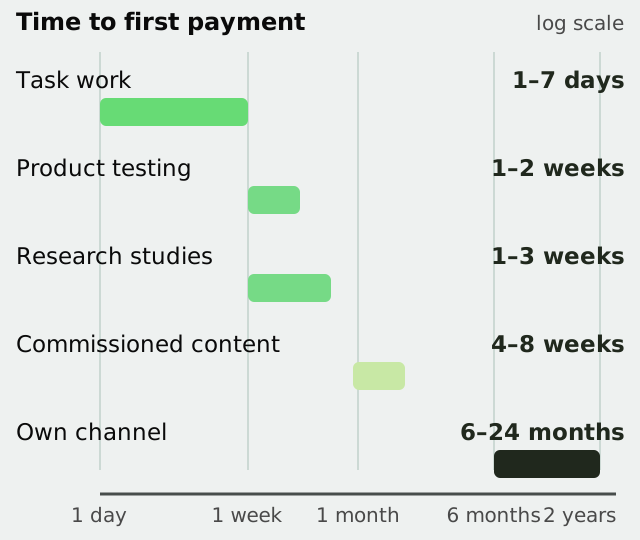
| What you do with the phone | Hourly equivalent | First payment |
|---|---|---|
| Film short content for brands | $40 – $150 | 2 – 6 weeks |
| Moderated user research | $40 – $150 | 1 – 3 weeks |
| Unmoderated app and site testing | $20 – $60 | 1 – 2 weeks |
| Paid task and campaign work | $10 – $30 | 1 – 7 days |
| Local verification and photo tasks | $10 – $25 | 1 – 2 weeks |
| Selling things you already own | Variable | Days |
| Reward and passive apps | $0.10 – $1 | Weeks, if ever |
The gap between the top and bottom rows is a factor of several hundred, and both are commonly described as "making money from your phone".
The four things a phone is actually worth money for
It is a camera someone will point at a product
Brands buy short video filmed on phones because phone footage looks like a person rather than an advert, and that is precisely the effect they are paying for. A studio camera would be worse for the purpose.
This pays the best of anything on the list. Rates run from $75 for a simple clip up to several hundred once usage rights are priced in. No audience is required, because the brand posts it on their own channels and is buying the file.
The cost is a ramp. You need four sample clips before anyone books you, which takes a weekend, and then four to eight weeks of applying. The seven-day version of that setup covers what to film.
It is a screen someone needs tested
Companies need their apps and sites used on real devices by real people, because problems that only appear on a particular phone on a slow connection do not show up in a lab.
You record your screen, speak your thoughts aloud, and submit. Fifteen to thirty minutes at $10 to $60. Moderated sessions with a live researcher pay considerably more.
Every current phone records its own screen natively, so there is nothing to buy. The one thing that raises your acceptance rate is a cheap clip-on microphone, because room noise gets sessions rejected on a technicality.
It is a person standing in a specific place
This is the category people forget and it is the one a phone is uniquely suited to.
Businesses need to know things that can only be checked physically or regionally: whether a product is actually on the shelf in a particular chain, what a competitor's window display looks like this week, how a website renders for someone with an address in another country, whether a delivery experience matches what the listing promised.
None of that can be answered remotely or by software. It needs a person with a camera in a location, and the rate reflects how narrow the eligible pool is. Work restricted to your city or country competes against far fewer people than an open global task.
It is a recorder for your own opinion
Paid feedback on adverts, packaging, interfaces and content. You watch or use something and report what you noticed, with timestamps. $10 to $60 a session.
The skill is being specific. "I lost interest at 0:07 when the text got too small" is worth ten times "it was fine", because the first can be acted on and the second cannot.
Why the passive apps pay so little
The ceiling is set by advertising economics and nothing you do moves it.
An advertiser pays roughly $5 to $30 for a thousand video impressions. The app keeps most of that. What reaches you is a fraction of a cent per view, at fifteen to thirty seconds a view. An hour of continuous watching generates a few dollars of advertiser spend in total, and you get a slice of it.
Three mechanics push the real rate lower again.
Points instead of money. A reward quoted in coins means nothing until you find the conversion, and the conversion is rarely on the same screen.
Withdrawal minimums. A $25 threshold at 40 cents an hour is sixty hours before you can touch anything. A meaningful share of users never reach it, and unreached balances cost the app nothing.
Caps and attention checks. Daily earning limits plus prompts to prove you are present. You can neither leave it running nor scale it.
Setting the phone up properly
Almost nothing is needed, which is worth saying because the temptation is to buy things instead of starting.
Worth buying, in order. A clip-on microphone at $20 to $50 if you speak on camera — this changes acceptance rates more than any other purchase. A phone tripod at around $15, because handheld footage reads as unsteady rather than authentic. That is the list.
Not worth buying. A new handset, a ring light, a gimbal, editing subscriptions, or any course. A phone from the last four or five years exceeds what buyers need.
Worth doing, free. Find the window in your home with reliable indirect daylight and note the hours. Learn where your phone's screen recorder and its audio toggle live. Set video to the highest resolution at 30fps. Clear enough storage to record without the phone refusing halfway through a session.
The offers built to waste your time
The phone-earning category attracts more noise than most, and the patterns repeat.
Pay described, work not described. "Earn $400 a week from your phone" with no statement of the task. Real listings say what you would be doing because they need someone who can do it.
Payment in gift cards only. Not automatically bad, but it caps what the earnings are worth and it is often paired with a high threshold.
Referral-dependent earnings. If income comes from people you sign up rather than work you complete, the recruitment is the product.
Any request for money. Access fees, starter kits, premium tiers that unlock the good tasks, background checks you fund yourself. None of these exist in legitimate work.
Permissions that do not match the task. An app that pays for watching video has no reason to want your contacts, your SMS, or continuous background location. Read what is being requested and ask what it is for.
Apps that pay for your data without saying so. Some pay real money to monitor your browsing or app usage, which is a legitimate transaction if it is disclosed. It becomes a problem when the data collection is the actual business and the earning is the cover story. Check what is collected before installing, not after.
Which tasks suit a phone and which do not
Not everything transfers, and picking work that fights the device wastes evenings.
Well suited
Filming video, taking photographs, screen recording, voice recording, location verification, checking how a site or app behaves on mobile, short-form written feedback, anything that needs you to be physically somewhere.
Badly suited
Long-form writing, spreadsheet work, transcription of any length, design, and most editing. All are technically possible on a phone and all take two to three times as long, which halves an already modest hourly rate.
Depends on the phone. Video editing, which recent handsets handle acceptably for simple trims and older ones do not. If a brief asks for raw footage rather than an edit, that constraint disappears entirely, and most UGC briefs do ask for raw.
The useful filter before accepting any task: would this be faster on a laptop? If the answer is much faster, the task is not phone work, and taking it anyway is how people conclude the whole category pays badly.
Getting paid, and what quietly disappears
The rate is only half the number. Check these before committing to any platform.
Currency and conversion. What are you credited in, what do you withdraw in, and how does that rate compare to mid-market? Two to four percent is commonly taken here without being shown.
Withdrawal fees. A flat $3 on a $40 withdrawal is seven and a half percent. Batching withdrawals fixes flat fees; nothing fixes percentage fees.
Minimum thresholds. Divide by your realistic monthly earnings. If the answer is months, your money is stranded by design.
Whether the work is funded before you start. On a marketplace that holds the money up front, funded means the buyer's money is already held. Unfunded means you are extending credit to a stranger for a $20 job.
Whether rejection can be appealed. If work can be refused with no explanation and no route to challenge it, the whole risk of somebody's opinion sits with you.
A realistic first month
Week one
Register on two task or testing platforms. Fill in every profile field, especially country, languages and which devices you own — device coverage is what gets you invited to testing work and most people leave it blank. Expect no income.
Week two
Take small tasks and push one all the way through to a withdrawal, even for a few pounds. Completing the payment loop once teaches you more than any review, and you learn it while the balance is too small to matter.
Week three
Volume, now that the process is familiar. If content work appeals, film four spec clips this week.
Week four
Count what you earned per hour including unpaid time, drop the weakest source, and put those hours into the strongest.
Fifty to two hundred dollars in month one is normal. Month two is usually double, because the setup cost is paid once.
Protecting the phone and the accounts on it
Small thing, rarely mentioned, occasionally expensive.
Keep work accounts separate from personal ones. A distinct email address for platform signups. It costs nothing, keeps the record-keeping simple, and means a marketing deluge lands somewhere that is not your inbox.
Read permission requests against the task. A feedback app has no reason to need contacts or SMS access. Location makes sense for verification work and makes none for watching video. Granting everything by reflex is how a $12 task ends up costing something harder to price.
Do not install anything that asks to be sideloaded. Legitimate work platforms are in the app stores or run in a browser.
Use the phone's own screen recorder rather than a third-party recording app. It is already there, it is not selling anything, and it does not watermark.
Back up delivered work before you submit it. Platforms occasionally lose uploads, and being able to resend immediately is the difference between a minor annoyance and an unpaid afternoon.
Moving up rather than adding hours
The instinct after a decent month is to install more apps. The better move is to change what the phone is doing.
Going from task work to filming content roughly quadruples the rate on the same device and the same hour. Going from general tasks to work restricted to your city, your country or your language cuts the competition and raises the rate without any new skill at all.
Adding hours has a ceiling at the number of evenings you have. Changing what the hour is worth does not.
That is the only version of this that turns into meaningful money. The comparison of what each home side hustle pays sets out which options have a rate curve and which stay flat however good you get.