There is no shortage of side hustle ideas. There are lists of eighty, and they are the reason so many people try four things, finish none, and conclude the whole category is a waste of time.
The useful work is not adding a eighty-first idea. It is narrowing. Four things about your situation eliminate most of the options, and what remains is usually one or two routes rather than a menu.
That is as true of an online side hustle as an offline one, and the online ones need it more, because the barrier to starting is low enough that you can begin six and finish none without ever noticing the pattern.
The four constraints
Answer these before looking at any list. Each one removes more options than the last.
When are you actually free?
Not how many hours in total — which hours, and how predictable they are. Short unpredictable evenings and long uninterrupted weekend blocks suit completely different work.
How soon do you need money?
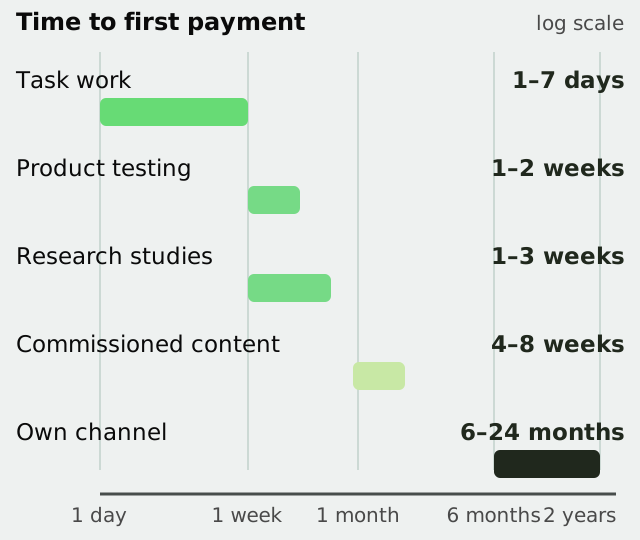
Within two weeks, within two months, or no particular rush. This eliminates more than anything else, because most of the better-paid routes take a month to produce anything.
What do you already have?
A professional skill, a second language, an unusual device, time in a specific place, a car. Each is worth more than enthusiasm and most people discount theirs.
Do you need the rate to climb?
Some routes pay the same in month twelve as in week one. Others compound. If this is a long-term project rather than a gap to fill, that single question outranks the other three.
When you are free decides more than you think
This is the constraint most lists ignore entirely, and it rules things in and out immediately.
Short weeknight blocks
Two hours, unpredictable, after a full day of something else. This rules out live scheduled commitments and anything needing deep concentration or a long setup. What survives is asynchronous work with a real deadline — task work, testing, transcription, content briefs, freelance work in a skill you already have.
Covered properly in what fits around a day job.
Long weekend blocks
Six to ten hours, uninterrupted. This is where work with a setup cost becomes economic — filming a batch of content, a freelance project needing continuity, or local in-person work that a Tuesday night cannot accommodate.
The trade-offs are worked through in what a long block is good for.
Using a weekend for work you could do in twenty-minute fragments is the most common way people undersell the time they have.
How soon you need money
Within two weeks
Two routes pay that fast and both take beginners: paid task work and app or website testing. Payment follows approval, typically one to seven days. Neither compounds, which is fine — the objective here is cash, not a career.
If the target is a specific figure by a specific date, the arithmetic for $500 works it through, including the part where selling something beats working for it.
A month or more
The set widens considerably and the rates roughly triple. Freelancing a work skill, content produced for brands, research participation, virtual assistance, transcription and translation all become available.
What genuinely takes people with no track record is the honest starting list.
The honest numbers
Per hour, across the routes people actually ask about.
| Route | Hourly | Rate climbs? |
|---|---|---|
| Reward and paid-to-watch apps | $0.20 – $2 | No |
| Surveys | $1 – $4 | No |
| Basic task and microwork | $10 – $25 | Barely |
| App and website testing | $15 – $60 | Slightly |
| Transcription | $12 – $25 | Slightly |
| Mystery shopping and local checks | $15 – $40 | Somewhat |
| Content and creator work | $20 – $80 | Yes |
| Translation | $25 – $90 | Yes |
| Freelancing a work skill | $25 – $80 | Yes |
| Specialist and credentialled work | $40 – $150 | Yes |
The top two rows are on the table to be ruled out. Reward apps and surveys are the most recommended answers to this question and among the worst paid, with effective rates that collapse once screen-outs and withdrawal thresholds are counted. Why the paid-to-watch arithmetic never works sets out the numbers, and what a phone alone can earn covers the mobile version of the same trap.
The gap between the top and bottom of that table is a factor of fifty, and it has almost nothing to do with how hard the work is.
What actually sets the rate
Not difficulty. Not effort. How many other people can do the same task.
Drawing a consistent bounding box for eight hours is genuinely hard and pays near the bottom, because several million people can do it. Reviewing a clinical document pays near the top because almost nobody can. Everything in between follows the same rule.
Which makes the useful question "what makes me part of a small pool", and four things do it:
A professional qualification
Clinical, legal, financial, engineering, teaching, advanced technical. Business-to-business research and expert review pay multiples of general rates for exactly these backgrounds, and most people in them never look.
A language other than English
Translation, localisation, content review and market-specific task work. Chronically short of people almost everywhere, and the scarcer the pair the better it pays. What language work is worth covers the range.
Being somewhere specific
Local in-person work pays better than the online equivalent because the eligible pool is everyone within driving distance rather than everyone with a laptop.
Owning unusual equipment
An older phone, an uncommon device, a decent microphone. Device coverage is a real constraint for the people commissioning testing work.
The routes worth a closer look
Rather than eighty options, these are the ones that hold up when you check the numbers.
Sell a skill you already use
The best-paid route available to most people and the most consistently skipped, because it does not feel like a side hustle. Freelance writing and virtual assistance are the two most common entry points, and both take a work skill rather than a new one.
Content produced for brands
Making short video, photos or written content a company uses. No audience required for the commissioned version, which surprises people. Start with what the job actually is, then what it pays once usage rights are priced.
Task, testing and research work
Small, verifiable jobs where the value is who you are and where you are. Fast to start, pays within days, and worth checking the platform first. Paid research studies sit at the top of this group for hourly rate.
Work that pays for your location
Mystery shopping and local checks, where being able to reach a place is the qualification. Better paid than the online equivalent, with a travel cost the listing never mentions.
The newer routes worth comparing are UGC creator work, short reaction-video briefs and paid app testing. They reward a concrete output rather than hours online, and video work usually has the highest ceiling for beginners willing to appear on camera.
What to avoid, without exception
Four more patterns, all common enough to recognise on sight. Earnings that depend on recruiting other people rather than on work you complete. Buy-and-refund schemes where you purchase something against a promise of repayment plus a fee for a favourable review — the refund frequently does not arrive and the review is fraudulent either way. Pay described enthusiastically while the work is never described at all. And anything that arrives unsolicited after you posted somewhere that you needed money.
The twelve-point check on any platform is the version to run before spending an evening rather than after. What community recommendations get right and wrong is worth reading alongside it, because the same handful of suggestions circulate regardless of whether they still pay.
The mistake that costs the most
Starting four things at once.
Every route has a setup cost in time before it returns anything — profiles, assessments, samples, learning what a platform actually wants. Four simultaneous starts means paying four setup costs, spreading attention across all of them, and reaching the point where any single one becomes profitable in none of them.
One route for a month beats four routes for a week, and it is not close.
The pattern that works is unglamorous. Pick one. Complete every profile field, especially country, languages and devices, because matching runs on those and a blank field silently removes you from work you would have won. Push one job all the way through to money landing in your own account. Then do volume for a fortnight before evaluating anything.
Month one is typically $50 to $250 and feels like failure. Month two is usually double, because the setup cost is paid once rather than repeatedly, and what the curve to a recurring four-figure month looks like carries it forward from there, including the month where something breaks.
The question that decides year two
Most routes have no rate curve. Basic task work, surveys, reward apps and general microwork pay the same in month twelve as in week one, however good you get. The only way to earn more is to work more hours, and that has a hard ceiling at the number of evenings and weekends you actually own.
The routes that climb do so because you become harder to replace — a specialism, a language, a portfolio, a client who returns. That is the whole difference between a side income stuck at $200 a month and one that reaches four figures.
So if this is a stopgap, take the fast routes and ignore everything about compounding. If it is meant to become something, the first few months are better spent acquiring the thing that narrows your pool than optimising how many tasks fit into a Tuesday.
The full comparison of what each option pays sets them against each other with the honest hourly, and where the listings actually are covers finding the work once you have chosen. For anything you take on, what contractor status costs in tax and protections applies from the first payment rather than after a threshold.